
What Is AlphaFold? A Plain-English Guide to AI and Protein Structure
- The 50-year problem: why protein shape was so hard to figure out
- What AlphaFold is, in plain English
- The Nobel-winning breakthrough
- What AlphaFold3 changed: from single shapes to interactions
- Why this matters for drug discovery
- The limits: what AlphaFold cannot do
- Why it matters for the future of medicine
- AlphaFold is an artificial intelligence system from Google DeepMind that predicts a protein’s 3D shape from its amino acid sequence, solving a problem that had challenged biology for roughly 50 years.
- The breakthrough was significant enough to earn a share of the 2024 Nobel Prize in Chemistry.
- AlphaFold has predicted the shapes of more than 200 million proteins and made them freely available to researchers around the world.
- AlphaFold3, released in 2024, went further by modeling how proteins interact with DNA, RNA, and drug-like molecules, which matters directly for drug discovery.
- AlphaFold is a powerful head start, not a finish line. Its predictions are best taken as strong hypotheses that should still be validated.
Few technologies in life sciences have moved from research lab to household name as quickly as AlphaFold. It is cited in Nobel announcements, investor decks, and news headlines, and is often held up as the clearest proof of how artificial intelligence is changing science.
It’s fair to say that everyone who works in life sciences would recognize AlphaFold by name and would have at least a sense of what it is, but fewer are able to explain what it actually does or how it does it.
AlphaFold addresses one of the oldest and most stubborn challenges in biology: figuring out the three-dimensional shape of a protein. A protein’s shape determines what it can do, which diseases it plays a role in, and whether a drug can act on it.
At California Life Sciences, we work with organizations across the entire ecosystem, from first-time founders to established research teams, and AI-driven tools like AlphaFold are part of the conversation at every stage. This guide is a plain-English explainer, written for the curious non-specialist. We will cover what AlphaFold is, how it works, why it won a Nobel Prize, what changed with AlphaFold3, and where it still falls short.
1. The 50-Year Problem: Why Protein Shape Was So Hard to Figure Out
Proteins are biological workhorses. They build tissue, carry signals, fight infection, and run nearly every process that keeps a cell alive. Each protein starts as a simple chain of building blocks — amino acids — strung together in a specific order. That order is written directly in our genes, and science’s ability to “read” the sequence has improved to the point that it’s relatively quick and cheap today.
But it gets more complicated. That flat chain folds up into an intricate three-dimensional shape, and the shape is what gives the protein its function. Get the shape right and you can understand how a protein works, why a mutation causes disease, and where a drug might attach to switch it on or off. The problem is that predicting the folded shape from the amino acid sequence alone is (or at least, was) extraordinarily difficult. The number of ways a single protein could theoretically fold is astronomical, and for about 50 years the challenge of predicting that final structure stood as one of biology’s grand unsolved problems.
Before AlphaFold, the only reliable way to see a protein’s true shape was to determine it experimentally, using painstaking laboratory methods such as X-ray crystallography and cryo-electron microscopy. These techniques work, and these remain essential tools, but they are slow and expensive. Mapping a single protein could take months or years of specialized effort, and many proteins resisted the process entirely. After decades of work, researchers had solved more than 200,000 structures, a tiny fraction of the proteins known to exist.
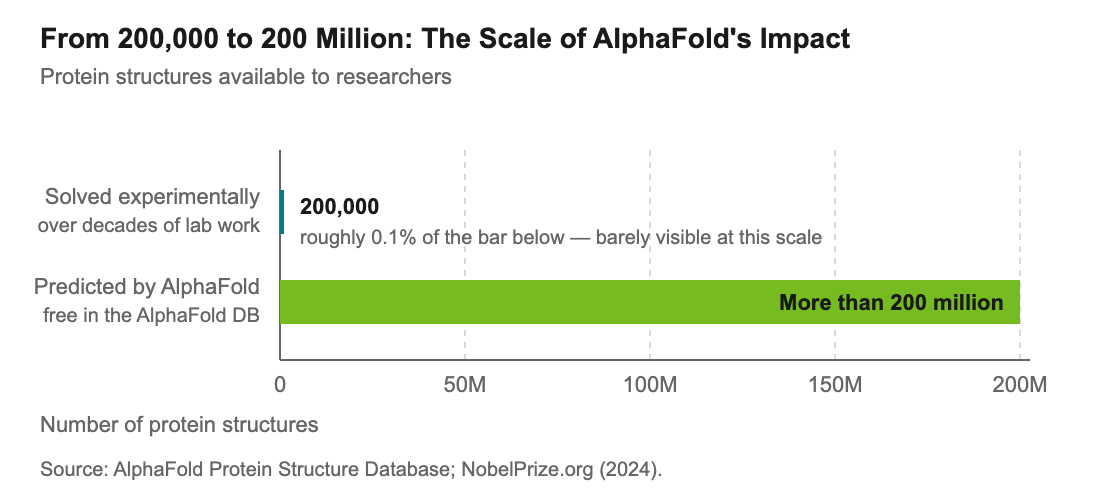
Decades of laboratory work produced a sliver of what AlphaFold predicted in a few years — the experimental total is barely visible at the same scale.
2. What AlphaFold Is, in Plain English
AlphaFold is an artificial intelligence system, developed by the research lab Google DeepMind, that predicts a protein’s 3D structure directly from its amino acid sequence. In practical terms, it does in hours what used to take a laboratory months or years, and it does so with a level of accuracy that surprised even longtime experts in the field.
So how does AlphaFold work? At its core, it is a deep learning pattern-recognition system. It was trained on the full public library of protein structures that scientists had already solved the hard way. By studying how tens of thousands of known sequences correspond to known shapes, the system learned the underlying rules. When given a new sequence, it looks across related proteins from other organisms for evolutionary clues, then assembles and refines its best prediction of the final folded shape. It also reports how confident it is about each part of the structure, so researchers know which regions to trust and which to treat with caution.
The field took notice in 2020, at a long-running scientific competition known as CASP, where teams compete to predict protein structures that have been solved experimentally but not yet published. AlphaFold’s second version, AlphaFold2, performed so well that some observers went as far as to say that the decades-old structure prediction problem was essentially solved. For a challenge that had defined a generation of research, that is a remarkable claim, but the results back it up.
3. The Nobel-Winning Breakthrough
The significance of that achievement was formally recognized in October 2024, when the Nobel Prize in Chemistry was awarded for work on proteins. One half of the prize went to Demis Hassabis and John Jumper of Google DeepMind for protein structure prediction, the work behind AlphaFold. The other half went to David Baker for computational protein design, a related advance focused on building entirely new proteins from scratch. Together, the awards cemented AI and computational analysis as central tools of modern biochemistry.
What made AlphaFold worthy of the honor was not only its accuracy but its reach. After confirming that the system worked, the DeepMind team used it to predict the structure of nearly every protein known to science, then made the results public. The AlphaFold Protein Structure Database now holds more than 200 million predicted structures, and it is free for anyone to use. By the time of the Nobel announcement, it had been accessed by more than 2 million people across 190 countries, a level of adoption that few scientific tools ever reach.
That combination of quality and openness is a large part of why AlphaFold changed the field so quickly. A researcher who once faced months of experimental work and untold expense can now begin with a credible predicted model in an afternoon.
4. What AlphaFold3 Changed: From Single Shapes to Interactions
If AlphaFold2 answered the question “what shape is this protein,” the next version set out to answer a harder and even more illuminating one: “what happens when this protein meets something else.” Released in 2024 by Google DeepMind together with Isomorphic Labs, AlphaFold3 extended structure prediction beyond single proteins to model how proteins interact with other molecules, including DNA, RNA, and the small drug-like molecules known as ligands.
This leap matters because biology happens through interactions. A protein rarely acts alone. It binds to other proteins, latches onto genetic material, and responds to the small molecules that make up most medicines. Predicting these interactions moves the technology much closer to the questions researchers actually ask when they design a drug. According to its developers, AlphaFold3 delivered a roughly 50% improvement in accuracy for predicting how proteins interact with other molecules, compared with earlier methods. To say nothing of how much faster AlphaFold3 can arrive at a prediction.
Why This Matters for Drug Discovery
Most modern medicines work by attaching to a specific spot on a target protein and changing its behavior. Knowing the shape of that target, and how a candidate molecule might fit against it, is the foundation of structure-based drug design. AlphaFold makes that structural starting point far more accessible.
It can provide a usable model for proteins that were never solved experimentally, including some that were considered too difficult to study.
It can help researchers narrow down which drug candidates are worth testing in the lab, potentially saving time and resources early in discovery.
It gives smaller and earlier-stage teams access to structural insight that once required major infrastructure, helping level the playing field.
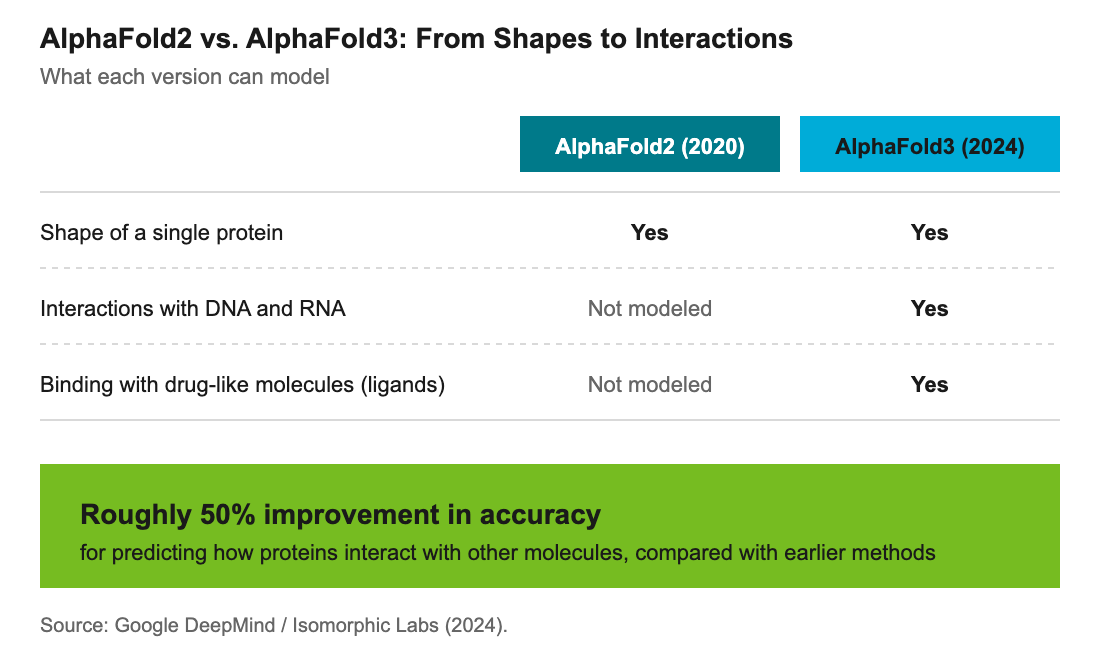
AlphaFold2 answered what shape a protein takes; AlphaFold3 addresses what happens when that protein meets DNA, RNA, or a candidate drug.
5. The Limits: What AlphaFold Cannot Do
For all its paradigm-pushing, AlphaFold is a brilliant starting point. It’s not the final answer. Like all technologies, AlphaFold has limits, and understanding them is part of using it well.
First, AlphaFold generally produces a single static snapshot of a protein, but real proteins are not frozen. They flex, shift, and change shape as they do their jobs. A single predicted structure can’t account for that motion. Second, confidence varies from protein to protein. Some regions, particularly the naturally disordered stretches of a sequence that do not fold into a fixed shape, remain hard to predict. It is possible to generate a confident-looking structure where the real answer is genuine disorder.
Most importantly, a prediction is a hypothesis, not a measurement. Even a high-confidence AlphaFold model can differ from the experimentally determined structure in ways that matter when a decision hinges on exact detail. Researchers widely regard AlphaFold predictions as valuable, accelerating hypotheses that speed up work, but not as a replacement for experimental validation when precision is critical. The most effective teams treat AlphaFold as a head start and use its models to focus their experiments rather than to skip them.
6. Why It Matters for the Future of Medicine
The deeper significance of AlphaFold is not any single prediction but the way the tool reframes a decades-old bottleneck. For most of modern biology, obtaining a protein’s structure was a major undertaking that often had to be planned for and funded on its own. Now, in many cases, structure is a reasonable starting assumption, and research can begin from there. That change ripples outward into basic science, diagnostics, and drug discovery, and it is already influencing how new therapies are pursued.
AlphaFold is also the clearest example so far of a broader shift, in which artificial intelligence moves from the edges of life sciences research toward its center. It is not the whole story of AI in biology, and it does not replace the scientists, the laboratories, or the years of careful validation that turn a promising target into an approved medicine. What it does is give that work a meaningful head start, and in a field where timelines are long and stakes are high, a head start can make a world of difference.
What is AlphaFold in simple terms?
AlphaFold is an artificial intelligence system from Google DeepMind that predicts the 3D shape of a protein from its amino acid sequence. Because a protein’s shape determines its function, this helps scientists understand how proteins work and how diseases might be treated. It solved a problem that had challenged biology for roughly 50 years.
AlphaFold works by learning patterns from the large library of protein structures that scientists had already determined experimentally. It studies how known sequences relate to known shapes, draws on evolutionary clues from related proteins, and then predicts the most likely folded structure for a new sequence. It also reports how confident it is about each part of the prediction.
In 2024, Demis Hassabis and John Jumper of Google DeepMind received half of the Nobel Prize in Chemistry for protein structure prediction through AlphaFold. The prize recognized both the accuracy of the system and its openness, since the team made more than 200 million predicted structures freely available to researchers worldwide.
AlphaFold2 predicted the shape of individual proteins with breakthrough accuracy. AlphaFold3, released in 2024, went further by predicting how proteins interact with other molecules such as DNA, RNA, and drug-like ligands. This focus on interactions makes it more directly useful for drug discovery.
AlphaFold is highly accurate for many proteins and reports a confidence score for each prediction. However, its results are best treated as strong hypotheses rather than final answers, since it can struggle with flexible or disordered regions. For decisions that depend on exact structural detail, predictions still need to be confirmed experimentally.
Most drugs work by binding to a specific protein, so knowing that protein’s shape is central to designing them. AlphaFold provides usable structural models quickly and cheaply, including for proteins that were never solved in the lab. This helps research teams prioritize which drug candidates to pursue and lowers the barrier to structure-based drug design.