
How California’s Life Sciences Ecosystem Compounds Its Advantage
- California is home to 336,505 direct life sciences jobs and generates $396 billion in annual economic output, more than any other state.
- The state leads the nation in both NIH funding ($5.246 billion) and venture capital investment ($21 billion in 2025), a combination no other state has come close to replicating.
- California’s advantage isn’t just its size. The ecosystem is self-reinforcing: every company, university, and fund that joins makes it more valuable for everyone already in it.
- The Bay Area, San Diego, Los Angeles, and Orange County each play distinct roles that the others can’t replicate, creating a statewide network stronger than any single cluster.
- Companies don’t just benefit from the California ecosystem. They’re part of what makes it valuable for everyone else.
- That advantage isn’t guaranteed. California’s 2026-27 budget permanently caps the R&D tax credit beginning in 2027, while China’s biotech sector has grown 400-fold in a decade: real pressures on the network that makes the state’s leadership possible.
People who try to explain California’s dominance in life sciences usually point to the same things: the universities, the money, the talent… maybe the weather. They’re not wrong, exactly. California does have world-class research institutions. It does attract venture capital at a rate no other state approaches. It gets the best and brightest minds, because of the connection to academia, the capital. And yes, the weather is great. But these are inputs. They’re not the answer.
There’s a better way to understand what’s happening here. California’s life sciences is an ecosystem. One where each participant — whether a startup, a research institution, an investor, or a service provider — reaps the rewards and at the same time, contributes to making the whole system more valuable.
The inputs are important, but they’re not the whole story.
At California Life Sciences, we work with companies at every stage and across every region of the state. What we see is that the companies that realize the most value from being in California aren’t just those that show up. They’re the ones that plug in: to peer networks, to investor communities, to academic partnerships, to the convenings and collaborations that make this ecosystem unique.
This piece sets out to explain why that is. Not because California’s leadership is guaranteed. It isn’t. The ecosystem described here took fifty years to build, and it’s the single hardest thing for any other region or country to replicate. But it’s not indestructible, and it doesn’t belong to California by default. Understanding how the network works is the first step toward recognizing what is actually at stake when the conditions that sustain it — research funding, tax policy, talent pipelines — are allowed to weaken.
1. The Usual Explanations Fall Short
Ask most analysts why California leads in life sciences and you’ll hear a familiar list: proximity to Stanford, UCSF, UCLA, and UC San Diego; a deep talent pool; and a venture capital market unlike anywhere else in the world.
These are real advantages. But they’re available, in varying degrees, elsewhere. MIT and Harvard anchor a thriving cluster around Boston’s Kendall Square. Texas has aggressively recruited talent and extended significant tax incentives. North Carolina’s Research Triangle has been a national cluster for decades. None of them have overtaken California, not because they lack the inputs, but because they haven’t replicated the system. That competition is real, but it is ultimately a contest over where American life sciences leadership happens to be located.
There is a separate, much larger contest underway, and the stakes are not regional. China’s biotech sector has grown roughly 400-fold over the past decade and is on pace to outspend the United States on R&D by more than 50% by 2030. China now accounts for approximately 30% of new innovative drugs produced globally — a share that has grown faster than any other country’s over the past decade, according to the Information Technology and Innovation Foundation. That is not a fight between states. It is a shift in where the world’s medical breakthroughs originate, and it puts American leadership in biomedical innovation, not just California’s, at stake.
What California has built isn’t a collection of ingredients, and it isn’t something that relocates easily. It’s a network with network effects: the same structural dynamic that explains why a social networking platform becomes more valuable as more people join it, why a marketplace with more buyers attracts more sellers, and why the best talent concentrates where the best companies already are. The inputs got the network started, but the network itself compounds.
2. The Numbers That Matter
The scale of California’s life sciences sector is documented in the 2026 California Life Sciences Sector Report. This year’s report is telling.
California’s life sciences sector generates $396 billion in annual economic output, the largest in the nation. The sector employs 336,505 people directly, with each direct job supporting 1.86 additional jobs in the broader economy, for a total of 1.02 million jobs statewide. The average life sciences wage is $188,883, two times the California average.
On research funding: California receives $5.246 billion in NIH funding annually, more than any other state. The top five recipients — UCSF, Stanford, UC San Diego, UCLA, and USC — collectively account for a disproportionate share of the nation’s most impactful biomedical research. University life sciences research expenditures total $9.32 billion across the state.
On capital: California attracted $21 billion in life sciences venture capital in 2025, also the most of any state, though fundraising trends have shifted meaningfully since the 2021 peak. For context, the Bay Area alone captured $15.6 billion — nearly three-quarters of the state’s total, and a figure that would rank near the top of any global comparison if the Bay Area were its own geography.
These numbers don’t describe magnitude alone. They describe density. And density, in network industries, is where the compounding begins.
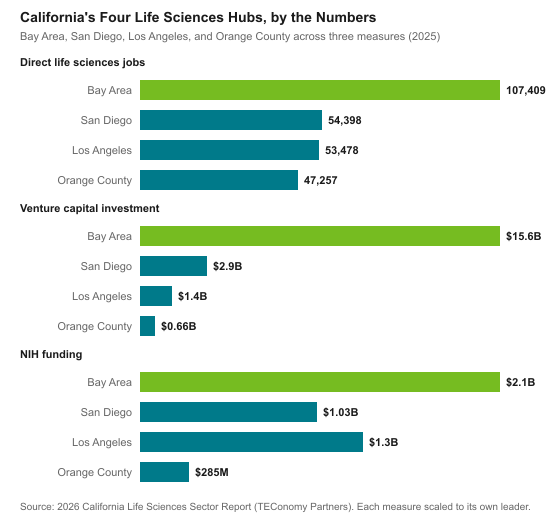
The Bay Area leads all three measures, but San Diego, Los Angeles, and Orange County each add scale no single hub could supply alone.
3. Why Density Isn’t Just Scale
It would be easy to read the previous section and conclude that California is simply bigger. More money, more people, more institutions, and therefore more output. But density in life sciences doesn’t scale linearly. It compounds.
When a founder in San Diego needs to hire a senior medicinal chemist, there’s a local talent pool trained at companies like Pfizer, Novartis, and Illumina, firms that have invested in workforce development for decades. When a Bay Area startup needs a lead investor for its Series B, the fund that closes the round is likely across town. When a regulatory question comes up that no one on the team has navigated before, there’s a peer — probably met at an industry event or a working group — who has been through it.
None of these advantages are available to companies building in isolation, even with strong teams and compelling science. Proximity to the California ecosystem reduces friction at every stage: time to hire, time to raise, time to answer hard questions. Research on biotech clusters consistently identifies proximity to knowledge networks, specialized suppliers, and investment capital as the primary drivers of cluster advantage, not the cost of operating within them.
The Bay Area, San Diego, Los Angeles, and Orange County each contribute distinct strengths to this system. The Bay Area is California’s global biopharma hub, with a location quotient of 2.12, meaning life sciences jobs are concentrated at 112% above the national average. San Diego is the research powerhouse, with a location quotient of 2.48 and per-capita research intensity that rivals any cluster in the world. Los Angeles is the fastest-growing hub: biopharma employment grew 2.3% in 2025, and NIH funding to Los Angeles organizations grew 4.1%, faster than the national average. Orange County is the medtech capital of the state, with a location quotient of 1.85 and nearly half of all its industry jobs concentrated in medical devices.
No single hub could replicate this combination. The fact that they exist together, within a state, sharing a regulatory environment, a talent market, and an association infrastructure, is itself a structural advantage.
4. The Self-Reinforcing Loop
Network effects describe a dynamic where value increases as more participants join. In life sciences, the effect runs deeper than most familiar examples, because the output of the network is science, and science is cumulative.
A company that licenses technology from UCSF, hires three postdocs from Stanford, and closes a round with a Bay Area fund isn’t just benefiting from the California ecosystem. It’s deepening it. Its hiring decisions train the next generation of scientists. Its research generates intellectual property that becomes the foundation for future spinouts. Its success draws the attention of international companies, which establish California operations, which create more jobs, which attract more talent.
This is the loop. And it explains why California’s dominance has proven more durable than any individual policy advantage, cost structure, or founder incentive program that competitors have tried to deploy. The California life sciences ecosystem rewards participation, and it keeps getting better because participation makes it so.
The data shows this clearly over time. California life sciences venture investment declined sharply from $30 billion in 2021 to $15.1 billion in 2023 as interest rates rose and risk appetite contracted across the sector. But by 2025, investment had recovered to $21 billion and deal activity was stabilizing. No state-level incentive drove that recovery. The network did: California remained the place where the most promising companies were building, where the most experienced investors were deploying capital, and where the talent to execute on both remained concentrated. The trough attracted buyers. The recovery attracted more.
The loop also explains why a newer hub like Orange County can climb fast once it is plugged into the network. Orange County’s medtech specialization didn’t develop in isolation. It draws on Bay Area capital, San Diego research talent, and a statewide regulatory and distribution infrastructure that no single county could have built alone. The same compounding that built the Bay Area over five decades is now accelerating Orange County’s rise over a much shorter timeline, because it doesn’t have to build the network from scratch. It only has to plug into the one that already exists.
Inputs can be replicated but network effect is organic. It takes decades to build, which makes it extraordinarily difficult to replicate or displace.
That durability cuts both ways, though. A network as dense and inter-connected as the California life sciences ecosystem doesn’t unravel quickly, but it doesn’t sustain itself automatically either. The 2026 California Life Sciences Sector Report shows the state’s first consecutive years of employment loss in its major life sciences regions, and venture capital into San Diego biotech startups fell 34% even as statewide funding stabilized. Those numbers aren’t catastrophic on their own. But they are the kind of early signal that, left unaddressed, compounds in the wrong direction, the same mechanism that built the advantage can erode it if the conditions that sustain it are allowed to weaken.
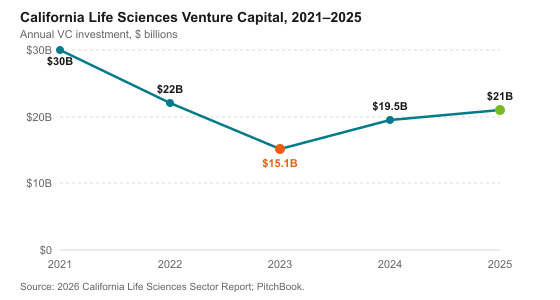
Venture funding fell by half after 2021, then rebounded to $21 billion by 2025 — a recovery driven by the network, not by any new state incentive.
5. What This Means for How Companies Build
The practical implication is that proximity to the California ecosystem is a strategic asset — but only for companies that use it.
Passive presence isn’t participation. A company that operates in California but doesn’t attend industry events, doesn’t engage in working groups, doesn’t tap its peer network for regulatory guidance, and doesn’t cultivate the relationships that produce unexpected partnerships isn’t capturing the network’s value. The best advice is to engage.
The companies that realize the most value from the California life sciences ecosystem tend to do a few things deliberately:
They make industry convenings a priority — not just as attendees but as contributors to the conversations that shape the field.
They use peer networks as operating infrastructure — treating relationships with other founders and executives as a resource rather than a social obligation.
They stay connected to academic research institutions — which remain the primary source of the early-stage science that drives discovery.
They pay attention to companies in adjacent areas and verticals — because the cross-pollination between drug discovery, diagnostics, digital health, and medical devices can be precisely where the most interesting ideas originate.
Building in California means building a network and building as part of a network. The people — and companies, and institutions — that do this grow along with the ecosystem. For a closer look at what that looks like in practice, see Scaling Your Startup: What’s Needed to Get From Idea to Exit.
6. Where California Life Sciences Fits
California Life Sciences is the state’s leading life sciences trade association, representing over 1,300 member organizations across the full life sciences ecosystem, from pre-seed startups to established global biopharma leaders.
CLS’s role in the network is connective. Through its events portfolio — thematic convenings, regional socials, and industry high-water marks like the annual CLS Pantheon Awards, and receptions at major industry gatherings like the BIO International Convention — CLS creates the in-person infrastructure through which ecosystem density translates into relationships. Through FAST California, a no-cost and equity-free mentorship program for early-stage founders, CLS gives the state’s most promising new companies structured access to the peer networks and expert advisors that would otherwise take years to build — see the Spring 2026 cohort for a sense of who comes through the program. Through working groups and committees, CLS channels the expertise distributed across the ecosystem toward shared policy and operational challenges.
The result is a network that doesn’t just work, it works together, as the California life sciences ecosystem. Networks like this are rare, and like all ecosystems, it exists in a balance and must be treated with care. What California has built over fifty years remains the hardest thing in life sciences to replicate elsewhere, and it’s incumbent on us — everyone and everything that make California life sciences ecosystem — to protect and sustain it.
FAQ: California Life Sciences Ecosystem
California leads the nation in every major metric: 336,505 direct life sciences jobs, $396 billion in annual economic output, $5.246 billion in NIH funding, and $21 billion in venture capital investment in 2025. The scale reflects decades of investment in research institutions, talent development, and capital infrastructure — and a self-reinforcing network that has been compounding since Genentech was founded in San Francisco in 1976.
Life sciences network effects describe the dynamic where each new participant — company, researcher, investor, or institution — makes the ecosystem more valuable for everyone already in it. Concretely: more companies mean a deeper talent pool, more capital activity, more cross-pollination between fields, and more shared institutional knowledge. The compounding happens because the outputs of the network — trained scientists, licensed IP, successful companies — feed back as inputs for the next generation.
Each hub contributes something distinct. The Bay Area leads in capital ($15.6 billion in VC, nearly three-quarters of the state’s total) and is home to one-third of all California life sciences employment. San Diego leads in research intensity, with a location quotient of 2.48 — 148% above the national average. Los Angeles is the fastest-growing hub, with biopharma employment up 2.3% and NIH funding growing 4.1% in 2025. Orange County is the state’s medtech capital, with a location quotient of 1.85 and nearly half of its life sciences jobs concentrated in medical devices. Together, the four create a statewide system no single cluster could replicate independently.
California leads Massachusetts in total employment, VC investment, and economic output. Massachusetts competes closely on research density, particularly around Boston’s Kendall Square. The key structural difference is that California’s multi-hub system — Bay Area, San Diego, Los Angeles, and Orange County — gives it a breadth and diversity of expertise that no single-cluster competitor can match.
Active participation compounds faster than passive presence. The companies that extract the most value from California’s ecosystem attend industry convenings, engage in peer networks, maintain academic partnerships, and cultivate cross-sector relationships. California Life Sciences membership is one of the most efficient ways to access the full breadth of the network, including events, working groups, the FAST mentorship program, and a large, active community of member organizations.
California Life Sciences is the state’s leading life sciences trade association, representing over 1,300 member organizations across the full ecosystem. CLS provides the connective infrastructure that allows ecosystem density to translate into relationships: events, peer networks, mentorship programs, working groups, and policy advocacy. It’s the organizing layer through which much of the ecosystem’s informal knowledge and relationship capital flows.