
Cell Therapy vs. Gene Therapy: What’s the Difference and Why It Matters
- The core distinction is simple: cell therapy delivers living cells to the patient, while gene therapy delivers genetic material.
- In cell therapy, the therapeutic effect comes from what the cells do once they are in the body, such as replacing lost tissue or attacking a target the body cannot clear..
- Gene therapy works by changing what a cell does, adding a working gene, silencing a faulty one, or correcting a mutation, usually via an engineered viral vector.
- The categories overlap: CAR-T is a cell therapy that depends on genetic modification, and CRISPR-based Casgevy edits a patient’s own cells outside the body.
- The distinction is not academic; it drives real differences in manufacturing, regulation, and cost, with several gene therapies priced above $2 million per patient.
- California is central to this work, from CIRM funding to academic programs at UCSF, UC San Diego, Stanford, and City of Hope.
The difference between cell therapy and gene therapy comes down to one question: what gets delivered to the patient? Cell therapy introduces living cells. Gene therapy introduces genetic material. Nearly everything else that separates them, the mechanisms, the manufacturing, the regulatory paths, follows from that single fact.
The two are often conflated, and not without reason; some of the most talked-about therapies of the past decade sit exactly where the categories overlap. At California Life Sciences, we work with founders, researchers, and investors across the state’s cell and gene therapy landscape, and the question comes up often enough that it deserves a clear answer.
1. What cell therapy is and how it works
Cell therapy treats disease by putting living cells into the body. Those cells might come from the patient (autologous) or from a donor (allogeneic), and they might be stem cells, immune cells, or other specialized types. The therapeutic effect comes from what the cells do once they are in the body: replace tissue that has been lost, restore a function the body can no longer perform, or attack a target the body has failed to clear.
Provenge (sipuleucel-T) — an immunotherapy for advanced prostate cancer — is a good example. A patient’s own immune cells are collected, activated against a tumor antigen in a lab, and returned to the body to mount a response. No gene is edited or added; the therapy works by delivering primed cells. Hematopoietic stem cell transplants, used for decades in blood cancers, follow the same logic: healthy cells do work the patient’s own cells cannot.
2. What gene therapy is and how it works
Gene therapy treats disease by delivering genetic material — instructions — into the patient’s cells. Instead of replacing cells, it changes what a cell does by supplying a working gene, silencing a faulty one, or correcting a mutation directly. The genetic cargo usually needs a delivery vehicle, most often an engineered virus such as an adeno-associated virus (AAV) that has been stripped of its ability to cause disease.
Gene therapy comes in two broad forms. In vivo gene therapy delivers the genetic material directly into the body, where it reaches the target cells on its own. For example, Luxturna (voretigene neparvovec), approved for an inherited form of blindness, is injected beneath the retina to deliver a functional copy of the RPE65 gene to the eye’s cells. Ex vivo gene therapy, by contrast, modifies a patient’s cells outside of, and then returns them to, the body.
3. Where the two overlap
The cleanest way to see the overlap is CAR-T therapy. To make it, a patient’s T cells are collected, genetically engineered in a lab to recognize a cancer target, multiplied, and infused back. Kymriah (tisagenlecleucel) and the CAR-T therapies that followed are, by delivery, cell therapies: what enters the patient is living cells. But those cells only work because their genes were rewritten first. CAR-T is a cell therapy that depends on gene therapy.
Casgevy, approved in late 2023 to treat sickle cell disease, makes the point again. It uses CRISPR to edit a patient’s own blood stem cells outside the body, then returns them. Is it cell therapy or gene therapy? Functionally, it is both. This is why the useful dividing line is not a wall between two separate fields but a question of what is ultimately delivered. Living cells and genetic material are the two levers, and many important therapies use both.
4. Why the distinction matters
The distinction is not academic. It shapes how a therapy is developed, manufactured, regulated, priced, and delivered.
Manufacturing is the clearest example. A gene therapy delivered in vivo, such as an AAV product, is made as a biologic at scale, with one production run serving many patients. An autologous cell therapy is made one patient at a time, using that patient’s own cells as the raw material, an entirely different logistics and cost-of-goods challenge. Regulation reflects the same split: in the United States, both fall under the FDA’s Center for Biologics Evaluation and Research, but the review weighs different risks, durable genetic changes and vector safety for gene therapy, cell sourcing and manufacturing consistency for cell therapy.
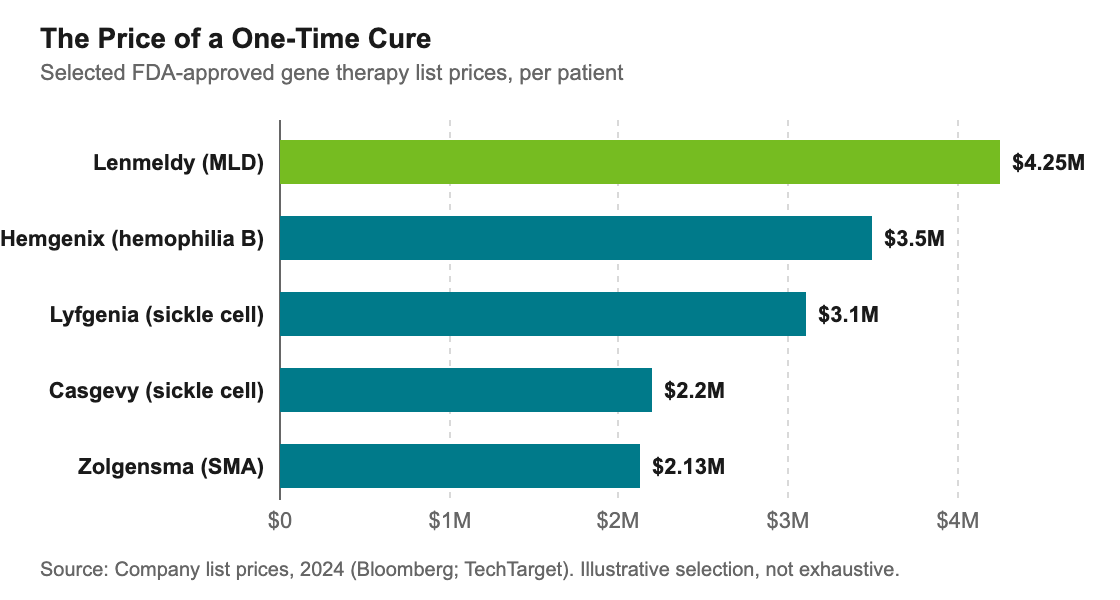
Cost follows too. Gene therapies can carry list prices above $2 million per patient, reflecting one-time, potentially curative treatments and complex manufacturing. For founders, investors, and clinicians, knowing which category a therapy belongs to is the fastest way to anticipate its development timeline, its manufacturing burden, and its route to patients.
5. AI’s growing role in cell and gene therapy
Artificial intelligence is moving quickly into cell and gene therapy. AI is being used to design better delivery vectors and capsids, predict off-target effects before an edit is made, streamline manufacturing and quality control, and match patients to the therapies most likely to help them.
Those same capabilities raise questions the field is actively working through: how to keep informed consent meaningful when the underlying science is this complex, how to ensure equitable access for the rare- and orphan-disease communities these therapies often serve, and how to keep human clinical judgment central as models take on more of the analysis. California Life Sciences is convening that conversation directly. A Day 2 panel at the CGT Symposium on the ethics of using AI in cell and gene therapy takes up exactly these questions.
A field with deep California roots
Much of this work traces back to California. The California Institute for Regenerative Medicine (CIRM), created by state voters in 2004, has invested billions of dollars in cell, gene, and regenerative medicine research, and academic medical centers including UCSF, UC San Diego, Stanford, and City of Hope have driven early cell and gene therapy programs. Many of the founders building the next generation of these therapies have come through California Life Sciences programs, including FAST California. It is a reminder that the distinction between cell and gene therapy is not just a definition to memorize, but a live and growing part of the science happening here.
FAQ: Cell Therapy vs. Gene Therapy
The difference between cell and gene therapy comes down to what is delivered to the patient. Cell therapy introduces living cells to replace, restore, or attack; gene therapy introduces genetic material to change what a cell does. Some therapies, like CAR-T, combine both approaches.
CAR-T is both. It is a cell therapy because what enters the patient is living T cells, but those cells are genetically engineered in a lab first, which is a gene therapy technique. It is the clearest example of how the two categories overlap.
In vivo gene therapy delivers genetic material directly into the body, where it reaches the target cells on its own. Ex vivo gene therapy modifies a patient’s cells outside the body and then returns them. Ex vivo approaches are where gene therapy and cell therapy most often meet.
These therapies are often one-time, potentially curative treatments with complex, low-volume manufacturing, and several gene therapies carry list prices above $2 million per patient. Autologous cell therapies add cost because each dose is made individually from the patient’s own cells. Pricing remains one of the field’s central access challenges.