
Biotech Salaries in California: What Life Sciences Jobs Actually Pay
- California’s life sciences sector pays an average wage of $188,883, roughly double the statewide average across all industries (2026 California Life Sciences Sector Report).
- That $188,883 figure is an industry-wide average and covers every position in a California life sciences company. It is not the salary one should expect from any single role.
- Medical scientists in California earn a median of $136,990, or 132% of the national median for the same occupation. Epidemiologists earn 127% of the national median and biological technicians 124%.
- Where within California matters: a biological technician’s median is $95,220 in the San Francisco metro area, $67,060 in San Diego, and $66,610 in Los Angeles.
- Federal wage data does not count equity, signing bonuses, or performance bonuses, which are a meaningful part of total compensation in this industry.
- California life sciences employment fell 1.8% in 2024–2025 while national employment grew 0.5%, even as the state held its lead in NIH funding and venture capital.
If more money means more problems, don’t take a life sciences job in California. Three things are true about life sciences pay in California:
- California pays a premium, and it pays it across nearly every role in the field.
- The premium is largest in research and discovery jobs, where the state’s concentration of companies and funding bids hardest for the same small pool of people.
- Where you live and work within California changes your paycheck significantly, sometimes by 40% or more for the same job title.
Search for “biotech salary California” and you will get a first page of results that’s full of aggregator sites and job boards touting numbers that disagree with each other wildly, sometimes by $100,000 or more for what is nominally the same question. At California Life Sciences, we publish the annual California Life Sciences Sector Report and work with companies at every stage from startup to multinational. So we’re able to get specific. Here is the comprehensive biotech / life sciences salary guide for California. We’ve included federal wage data for specifics, our own sector data for the context, and a clear explanation for why the numbers look the way they do.
1. The Big Picture
California’s life sciences sector pays an average wage of $188,883 per year, about twice the average across all California industries. That comes from the 2026 CLS Sector Report, which also counts 336,505 direct jobs and 15,660 life sciences establishments in the state.
It’s important to note, that number is a broad average across all life sciences jobs. It is not the salary everyone that works in life sciences in California should expect. Rather, it’s an industry-wide figure that includes every job across a slew of life sciences companies, from bench scientists to sales leadership to the executive team. It tells us that the sector pays well, but it doesn’t tell us what any specific job actually pays.
The gap shows up immediately when you look at occupations one by one. Of the life sciences roles tracked in federal wage data for California, only one has a median above the sector average: natural sciences managers, at $210,230. Everything else sits below it, and most sit well below it. Both numbers are honest. They just answer different questions.
$188,883 is the average annual wage for life sciences jobs in California, roughly double the state average across all industries, taking numbers from the CLS 2026 California Life Sciences Sector Report.
2. What Life Sciences Jobs Actually Pay in California
The table below is California-wide annual pay from the U.S. Bureau of Labor Statistics Occupational Employment and Wage Statistics program. Released in May 2026, it reflects wages as of May 2025.
| Occupation | California median | 10th–90th percentile |
|---|---|---|
| Natural sciences managers | $210,230 | $130,730–$330,050 |
| Data scientists | $141,590 | $77,480–$224,920 |
| Biochemists and biophysicists | $139,580 | $83,580–$208,210 |
| Medical scientists | $136,990 | $81,320–$180,060 |
| Bioengineers and biomedical engineers | $128,310 | $89,420–$179,810 |
| Biological scientists, all other | $113,530 | $69,770–$189,710 |
| Epidemiologists | $110,760 | $71,910–$168,220 |
| Microbiologists | $108,530 | $62,440–$183,420 |
| Chemists | $97,860 | $60,930–$164,150 |
| Biological technicians | $71,440 | $46,700–$121,670 |
| Chemical technicians | $59,510 | $44,070–$88,900 |
The second column in this table gets closer to the heart of the question: what will I earn working in life sciences in California. A medical scientist in California runs from $81,320 at the 10th percentile to $180,060 at the 90th. Biological technicians span $46,700 to $121,670. An incumbent’s location in California, their employer, their experience, and other factors will determine what they might earn within that band.
One thing to know about this data: it covers every employer in an occupation, so a biological technician at a university is counted alongside one at a biopharma company. That tends to pull the occupational figures below what industry employers pay.
3. Why California Pays More
California beats the national median in every one of these occupations but one. Medical scientists here earn 132% of the national median. Epidemiologists earn 127%, biological technicians 124%, and microbiologists 123%. Chemical technicians are the lone exception, at 99%.
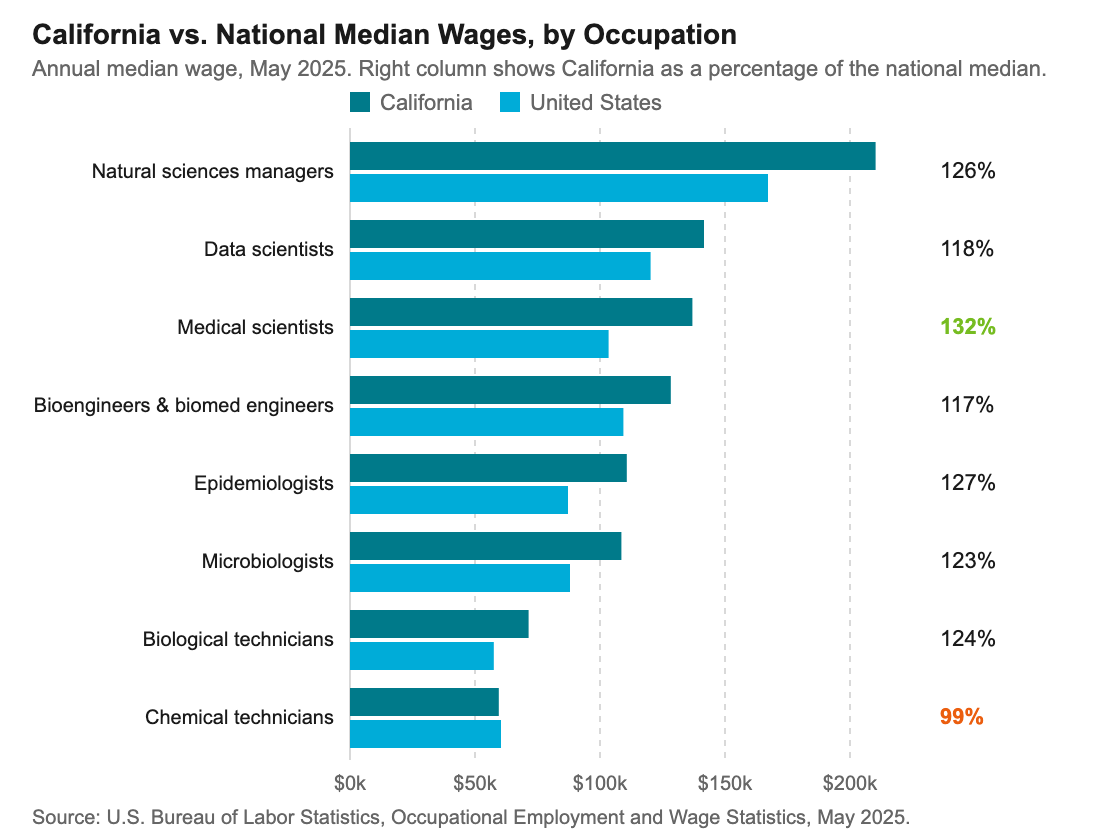
California’s wage premium holds across the field, and it is widest in research and discovery roles. Chemical technicians are the only occupation where the state does not lead.
The reason is density. The 2026 CLS Sector Report counts 15,660 life sciences establishments in California, $5.246 billion in NIH funding, and $21 billion in venture capital — all first in the nation. Four distinct regional clusters run at once, each with its own research universities, its own investors, and its own hiring pipelines.
In short, it’s a favorable environment for job seekers with employers competing for the same people in the talent pool. A scientist with a few years of experience in a California cluster has options within a short drive, and employers pay to keep people. While California has the highest cost of living of any state, the premium isn’t a cost-of-living adjustment. It’s what a dense market does to wages.
4. Where You Work Changes What You Earn
Within California, the specific area of employment is a major force on wages.
| Metro | Medical scientists | Biological technicians |
|---|---|---|
| San Francisco-Oakland-Fremont | $160,180 | $95,220 |
| San Jose-Sunnyvale-Santa Clara | $159,300 | $72,940 |
| Los Angeles-Long Beach-Anaheim | $134,890 | $66,610 |
| San Diego-Chula Vista-Carlsbad | $130,980 | $67,060 |
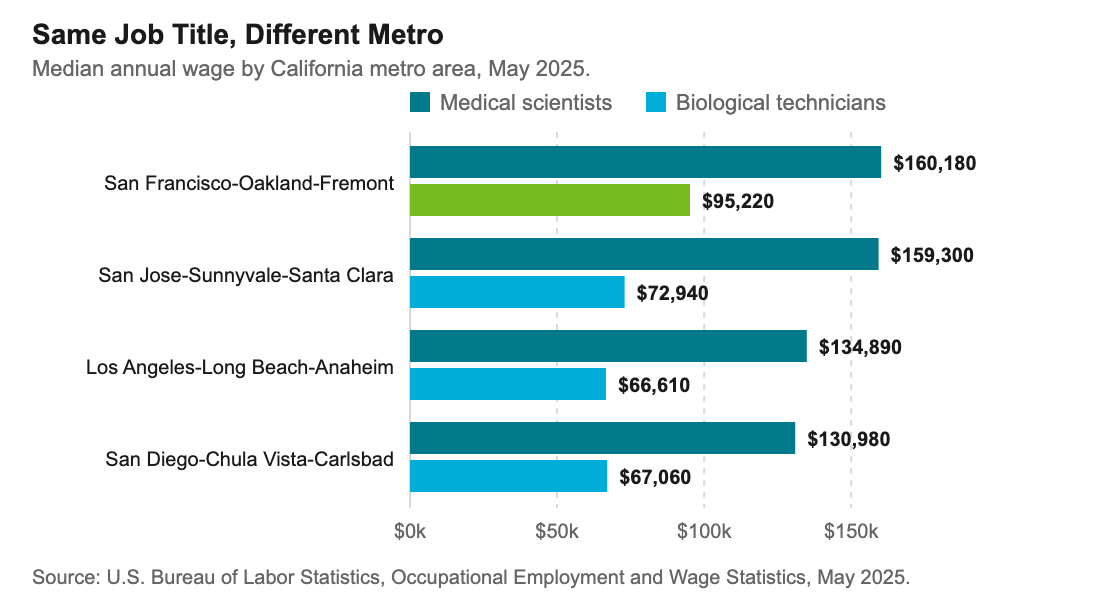
A biological technician earns 43% more in the San Francisco metro than in Los Angeles, with no change in job title.
A biological technician’s median in the San Francisco metro is $95,220. In Los Angeles it is $66,610, a 43% difference for the same job title.
The clusters have different characters, and that shapes who is hiring. The CLS 2026 Sector Report describes the Bay Area as the global hub for biopharma and a biotech powerhouse in research and development, San Diego as a startup dynamo and research powerhouse, and Los Angeles as a fast-growing and diverse emerging innovation hub. Orange County is the medtech capital of California, though federal wage data folds it into the Los Angeles-Long Beach-Anaheim metro area and does not report it separately. California’s Employment Development Department does break Orange County out, putting medical scientists there at a $138,671 median, essentially level with Los Angeles, though its figures are adjusted forward to early 2026 and run about 3% above the table above.
One note: It’s important to compare the wage numbers for a given area next to cost of living for that area before drawing any conclusions.
5. Salary Isn’t the Whole Package
Federal wage figures cover straight-time gross pay (base earnings before overtime and shift differentials) and some incentive pay (commissions, piece rates, and production bonuses). They do not count stock grants, signing, performance, or other bonuses. In California life sciences especially, those can make up a good part of an employee’s total compensation. For the employer side of the same equation, see our breakdown of what it costs to run a laboratory in California.
Grants and bonuses also move independently of salary. BioSpace reported that average U.S. life sciences salaries rose 9% from 2023 to 2024 while bonus and equity award totals fell over the same period. Two offers with identical base salaries can be worth very different amounts, and the difference can swing in either direction depending on the year and the company’s stage.
Other factors to consider in life sciences total compensation
- Base salary, and where it sits in the band for the role and level
- Target bonus, how it is calculated, and how reliably it pays out
- Equity type (options or registered stock units, RSUs), the number of shares, the vesting schedule, and the current strike price or valuation
- Signing bonuses and any repayment clauses attached to them
- Employer contributions to retirement and health coverage, which vary widely by company size
6. Strong Pay, Tighter Market
Life sciences employers in California compete for talent and so pay better than the average. But these employers also hired 1.8% fewer people in 2024–2025 while across the US, employment grew 0.5%. Medical devices and research and testing laboratories each fell 3.5%. Those are the steepest declines the 2026 Sector Report records outside of San Diego, where employment fell 4.0%. Job seekers may feel that difference in longer searches and more competition for job openings.
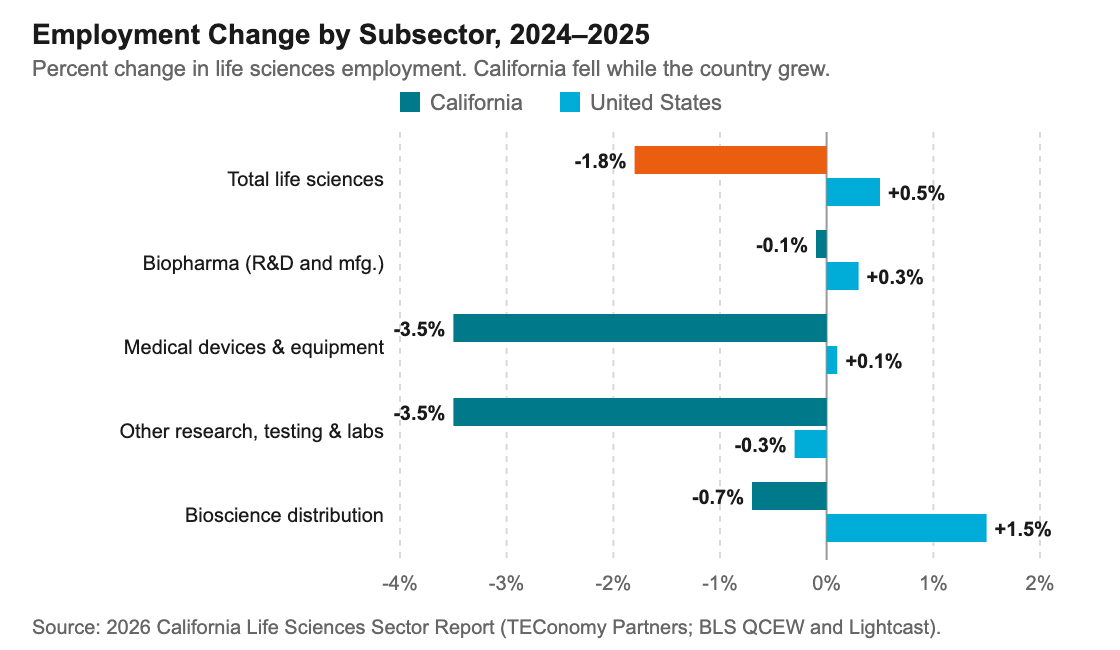
The decline is concentrated in medical devices and in research and testing labs, each down 3.5%, while the same subsectors held flat or grew nationally.
What hasn’t changed is the underlying position. California still leads the country in NIH funding and venture capital, still holds 15,660 life sciences establishments across four working clusters, and still pays roughly twice the state average wage. A tighter market means the search might take longer. It doesn’t mean the premium went away.
Despite some recent headwinds, the fact remains: for life sciences job seekers, employment opportunity lives here and for life sciences employers, some of the best life sciences talent in America calls California home.