
The Most Overlooked Cost Centers in Lab and Research Operations
- Nearly 67% of California life sciences companies have nine or fewer employees, making operational efficiency essential to survival, not just improvement. (2026 California Life Sciences Sector Report)
- The average U.S. research lab carries an estimated $29,000 in stranded assets — expired reagents, abandoned kits, and unused supplies — that represent pure waste on the balance sheet.
- Annual maintenance contracts on common lab equipment typically run 5–10% of the instrument’s purchase price, adding $15,000 to $70,000 per year depending on the instrument type.
- A four-person lab can spend $1,400 or more per month on shipping alone, a cost that rarely appears in early operating budgets.
- Procurement time is an underestimated labor cost: acquiring a single piece of equipment can consume 10 to 32 hours of staff time.
- CLS members access pre-negotiated pricing on lab supplies and business services through the Cost Savings Program, with average annual savings of $20,783 for companies with 1–20 employees.
California’s life sciences sector spans more than 15,600 establishments and supports over 336,000 direct jobs statewide. But according to the 2026 California Life Sciences Sector Report, nearly 67% of those establishments have nine or fewer employees. These are lean teams operating at pace, chasing milestones, and making real-time decisions about where every dollar goes.
In that environment, lab operating costs rarely get the sustained attention they deserve. Procurement happens close to the bench, not close to the budget. Equipment decisions get made in the moment. Shipping invoices move through accounts payable without much scrutiny. And the cumulative effect of dozens of small, overlooked line items can quietly drain months of runway.
At California Life Sciences, we work with companies across the full spectrum — from pre-seed founders in shared incubator spaces to established biopharma teams managing multi-site operations. The pattern we see consistently is that the most expensive cost centers often aren’t the obvious ones. They’re structural, incremental, and easy to rationalize when the science is moving fast.
This post identifies six areas where lab and research operations tend to leak money, along with what to look for and what to do about it.
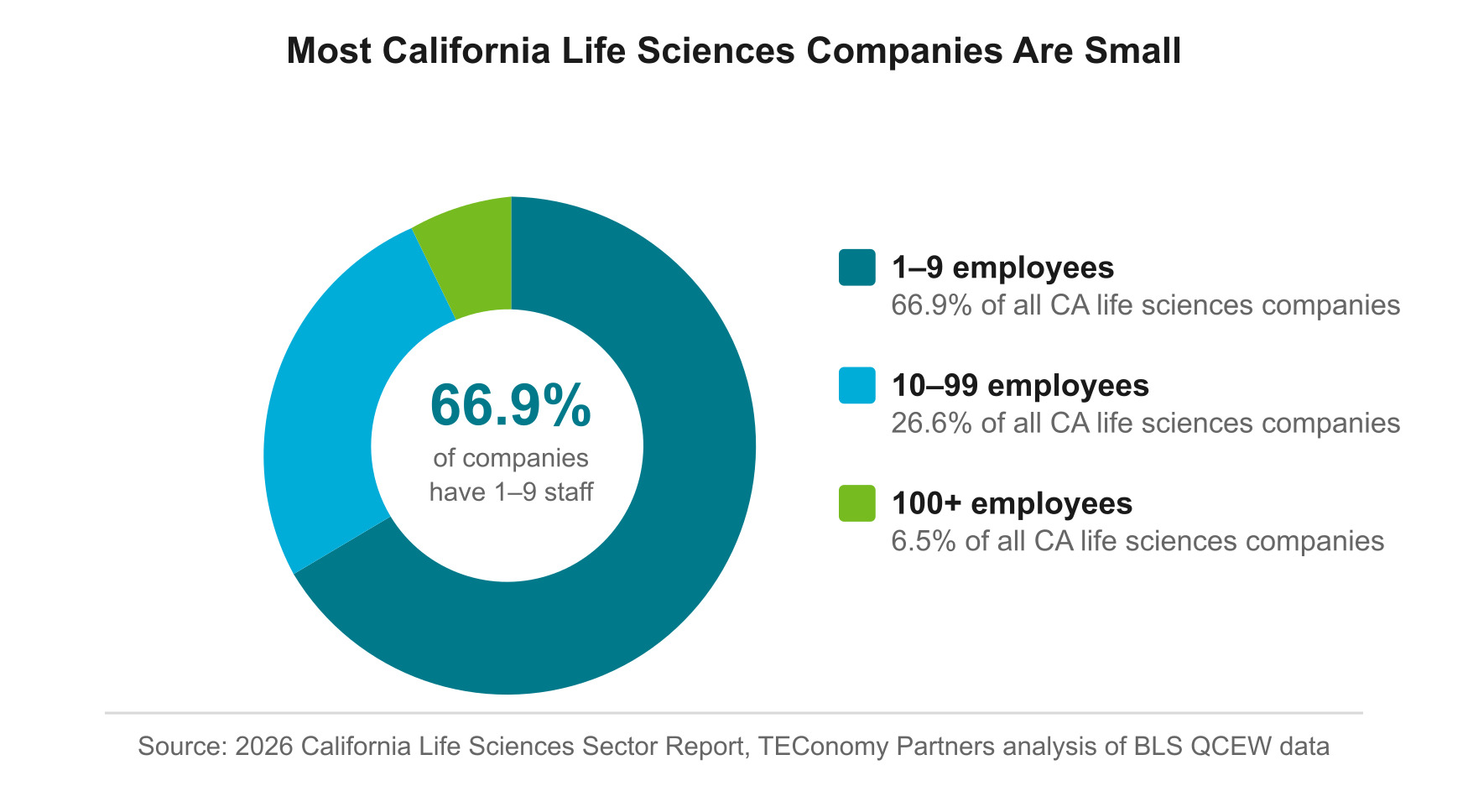
Nearly two-thirds of California life sciences companies have fewer than ten employees — making operational cost control a survival issue, not just an efficiency goal.
1. Lab inventory waste: what’s expiring on your shelves
Most labs have a shelf somewhere — or a freezer, or a cabinet — holding supplies that will never be used. Kits ordered for an experiment that pivoted. Reagents purchased in bulk to hit a volume discount threshold and then left to expire. Samples held past their viability window. The operational cost of this accumulation is rarely calculated, and it should be.
A peer-reviewed study published in PLOS ONE found that 60% of academic researchers have unused reagents and supplies in their labs, with an average of $29,000 in stranded assets per researcher — a figure that compounds across teams and across time. While academic labs and industry labs operate differently, the underlying behavior is the same: ordering in response to immediate need, without a system for tracking what’s already on hand.
The direct cost is the write-off. The indirect cost is the opportunity cost: capital tied up in inventory that could have been applied to active research.
What to watch for:
- No centralized inventory tracking system — orders made by individual researchers without visibility into existing stock
- Bulk purchases made to hit discount thresholds without realistic consumption forecasts
- Reagents and kits with approaching expiration dates that appear in lab audits but not in procurement decisions
- No formal process for repurposing or redistributing unused materials across teams
What to do:
Even a simple shared spreadsheet or lightweight LIMS can surface inventory patterns that lead to better ordering decisions. The goal is not to impose bureaucratic overhead on researchers — it’s to make visible what’s already being spent. Labs that conduct quarterly inventory reviews consistently identify materials to repurpose, delay reorders on, or cancel entirely.
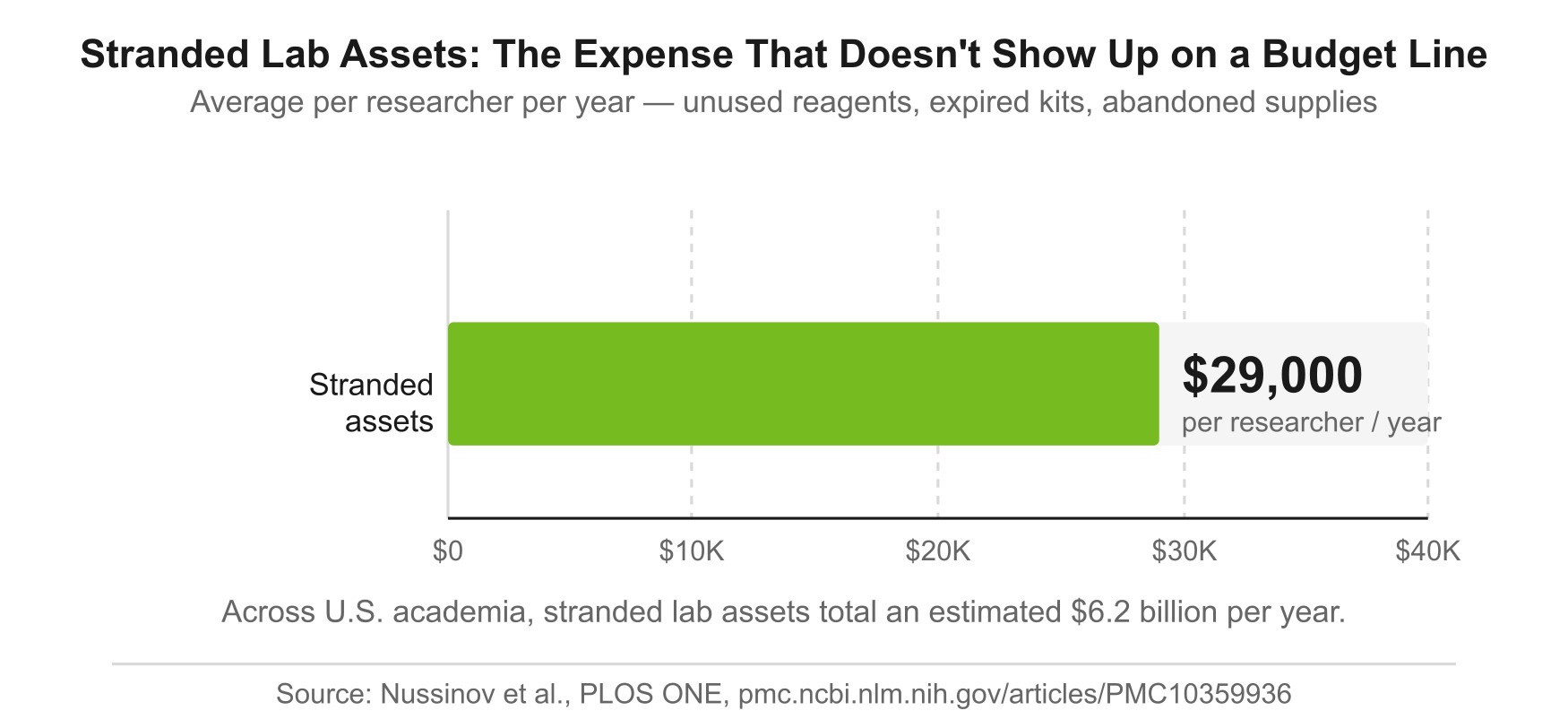
The average researcher carries $29,000 in unused, expired, or abandoned lab inventory — a sunk cost that rarely appears as a line item but compounds across teams and fiscal years.
2. Equipment maintenance contracts and idle utilization
When a lab acquires a major piece of equipment, the purchase price is the number that gets scrutinized. What often gets less attention is what that equipment will cost to keep running — and whether it’s being used enough to justify those costs.
Annual maintenance contracts (AMCs) are standard for most high-value lab instruments. Pricing typically runs 5 to 10% of the instrument’s original purchase price per year — for blood analyzers, that’s $30,000 to $70,000 annually; for centrifuges and microscopes, $15,000 to $40,000; for autoclaves, $10,000 to $30,000. These are not small numbers, and they recur every year regardless of how much the equipment is used.
The second dimension of equipment cost is utilization. Equipment scheduling is a well-documented blind spot for R&D labs: instruments sit idle while researchers wait to use them, and utilization data is rarely tracked in a way that would surface this inefficiency. The result is labs that carry the maintenance cost of instruments they don’t fully use, while researchers absorb the productivity cost of waiting for access.
What to watch for:
- Equipment AMCs that auto-renew annually without review against actual usage data
- Instruments that were purchased for a specific project and have since seen sharply reduced utilization
- No centralized booking or scheduling system — usage determined by informal negotiation between researchers
- Paying for manufacturer AMCs on instruments that qualify for third-party service at lower cost
What to do:
Run a utilization audit before each AMC renewal. For equipment with low usage, consider whether a third-party service contract at lower cost, or pay-per-incident service, makes more financial sense. For instruments with scheduling conflicts and high demand, a simple shared calendar or LIMS module can recover researcher productivity without adding equipment spend. Service partners like SU Group can also help organizations manage equipment maintenance and utilization more strategically as instrument fleets and operational demands grow.
3. Cold chain and hazmat shipping
Shipping costs feel like a small, fixed line item. For many life sciences labs, they are neither small nor fixed.
Biological materials, temperature-sensitive reagents, and hazardous compounds require specialized packaging, carriers, and handling — each of which carries surcharges that don’t show up in a standard shipping estimate. Dry ice, insulated packaging, certified hazmat handling, next-day air requirements for time-sensitive materials: these add up quickly. Research cited by Genetic Engineering & Biotechnology News found that a four-person lab can easily spend $1,400 per month on shipping and taxes alone — a figure that most founders don’t include in their early operating models.
The cost compounds when ordering behavior is reactive rather than planned. Rush shipping for forgotten supplies, split shipments because an item was backordered, and frequent small orders instead of consolidated purchasing all inflate the shipping line significantly.
What to watch for:
- No tracking of total shipping spend as a discrete budget line — costs absorbed into individual department budgets or general lab supplies
- Cold chain materials ordered on an ad hoc basis without forecasting
- Vendor selection driven entirely by product price, without accounting for shipping surcharge differences between suppliers
- Splitting orders across multiple vendors to find the lowest per-unit price, while ignoring the per-shipment cost of doing so
What to do:
Consolidate vendor relationships where possible to reduce shipment frequency. Build cold chain and hazmat shipping estimates into operating budgets from the first month of operations, not as a later adjustment. Review whether a vendor’s lower unit price still wins after their shipping surcharges are applied — it frequently does not. Specialized logistics providers like UPS Healthcare can also help organizations better manage cold chain logistics and time-sensitive shipping requirements.
4. Procurement time as a direct labor cost
The labor cost of buying things almost never appears on a P&L, but it is real and it accumulates.
Researching, comparing, sourcing, negotiating, and onboarding a single piece of equipment can take 10 to 32 hours of staff time, depending on the complexity of the purchase and how the lab’s procurement process is structured. At California’s average life sciences industry wage of $188,883 per year — cited in the 2026 California Life Sciences Sector Report — that’s between $909 and $2,908 of labor cost per instrument acquisition, before the instrument is even ordered.
Beyond the time cost, there’s the price cost. Life sciences labs that don’t have a procurement function, or don’t have access to pre-negotiated supplier pricing, typically pay retail. Research shows that labs settling for list price pay an average of 15 to 30% more than negotiated rates, with some plastic consumables chronically overpriced by as much as 80.3% compared to what comparable organizations pay through group purchasing channels.
What to watch for:
- No documented procurement process — decisions made by whoever needs something, on whatever timeline they need it
- Purchases made at list price as a default, with negotiation treated as optional rather than standard practice
- No visibility into aggregate spend by vendor or category — purchasing fragmented across individuals and departments
- High-frequency, low-value purchases consuming disproportionate researcher time
What to do:
Even a basic approved vendor list with pre-negotiated rates eliminates the research burden on individual buyers and ensures the organization captures volume pricing it has already earned. Access to a group purchasing network can extend this benefit to small companies that lack the volume to negotiate independently. Partners like VWR can also help streamline sourcing and purchasing across frequently used lab supplies and operational needs.
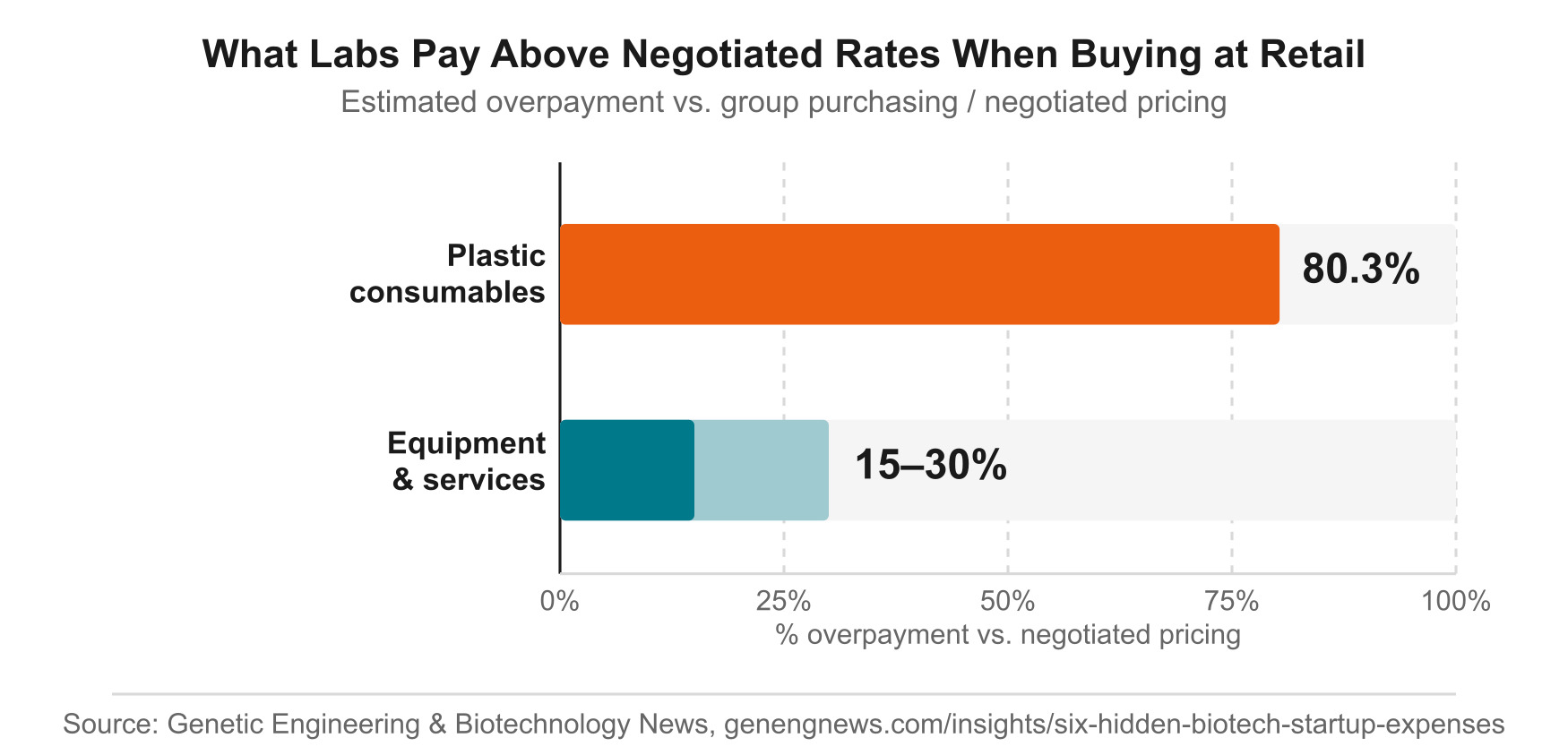
Paying retail for lab supplies consistently means paying 15 to 80% more than organizations with negotiated or group purchasing agreements pay for identical products.
5. Compliance and documentation labor
Every regulated life sciences lab carries compliance overhead. Equipment logs, standard operating procedure (SOP) documentation, training records, environmental monitoring logs, and audit-readiness maintenance are all legitimate requirements — but the labor cost of meeting them is rarely tracked as a discrete operational expense.
A lab manager responsible for overseeing instrument maintenance, safety compliance, and regulatory recordkeeping typically earns between $70,000 and $140,000 annually in California, with salaries in the Bay Area and Los Angeles frequently exceeding that range. A facility manager with occupancy safety and broader regulatory responsibility earns $80,000 to $160,000 in California’s competitive markets. These are explicit labor costs. What’s harder to see is the researcher and scientist time absorbed by compliance activity that could be reduced through better systems or process design.
For early-stage companies, this often surfaces as founders and senior scientists personally managing compliance tasks that don’t require their expertise — because there’s no one else to do it and no system to make it efficient. For established labs, it shows up as redundant documentation processes, manual record-keeping for tasks that could be automated, and audit-prep cycles that are more disruptive than they need to be.
What to watch for:
- Compliance tasks managed by researchers or founders rather than dedicated staff or systems
- Paper-based or disconnected documentation systems that require significant manual effort to compile for audits
- No regular review of which compliance processes could be streamlined, consolidated, or automated
- GxP documentation requirements that were established for a prior stage of operations and haven’t been scaled appropriately
What to do:
A compliance audit — separate from a regulatory audit — looks at how compliance work is being done rather than whether it’s being done. For many early-stage labs, this surfaces opportunities to simplify documentation systems, assign compliance tasks more appropriately, and reduce the scientist-hours spent on administrative overhead. Providers like PSC Biotech and FirmaTRUST help life sciences organizations modernize compliance systems, reduce manual documentation burdens, and improve audit readiness as operational complexity grows.
6. Lab space you’re paying for but not fully using
Lab space in California is expensive. In the Bay Area, San Diego, and Los Angeles — California’s three largest life sciences clusters — wet lab space commands premium rents, and the costs of occupancy extend well beyond the lease rate. Biosafety cabinets running 24 hours a day, fume hoods exhausting conditioned air continuously, HVAC systems maintaining stringent environmental specifications: the facility cost of keeping a lab operational is significant even when no experiments are running.
The underutilization problem often emerges after a program pivot, a headcount reduction, or a shift in research direction. The lab footprint was sized for a particular set of experiments. When that work changes, the space doesn’t shrink with it — but the costs remain.
The corollary issue is redundant equipment: instruments acquired for specific projects that have since concluded, now occupying expensive bench space and accruing maintenance costs without contributing to active research.
What to watch for:
- Lab space that was sized for headcount or program scope that no longer matches current operations
- Continuous HVAC and utilities costs for areas of the lab that are rarely or never used
- Equipment in storage or on standby mode that still requires environmental compliance maintenance
- No audit of how bench space maps to active research programs
What to do:
Shared lab facilities — incubators, co-working lab spaces, and flexible wet lab providers — have expanded significantly across California’s major life sciences hubs. For companies in transition, downsizing or consolidating lab footprint while retaining access to specialized equipment through shared facilities can dramatically change the cost structure. For established labs, a space utilization audit often identifies opportunities to sublease, reconfigure, or return footprint that’s no longer serving active research needs.
California’s broad network of research universities, shared core facilities, and life sciences incubators offers additional options for access to specialized instrumentation without the capital and maintenance overhead of ownership.
Efficiency isn’t a distraction from the science
The pressure on California life sciences companies is real. According to the 2026 California Life Sciences Sector Report, industry employment declined 1.8% in 2025 and VC deal volume fell 10.8% statewide — a reminder that even the nation’s leading life sciences ecosystem is not insulated from macroeconomic pressure.
In that environment, operational discipline is not a distraction from the science. It protects the runway that makes the science possible. The six cost centers outlined here — lab inventory, maintenance contracts, shipping, procurement labor, compliance overhead, and space utilization — rarely show up as single dramatic line items. They accumulate. They compound. And they are almost always recoverable with the right visibility and the right resources.
For CLS members, the Cost Savings Program provides access to pre-negotiated pricing across vetted partners covering lab supplies, business services, insurance, and more — extending group purchasing leverage to companies of every size.
FAQ: Lab operating costs in life sciences — what gets overlooked
The most commonly overlooked lab operating costs include reagent inventory waste, annual equipment maintenance contracts, cold chain and hazmat shipping surcharges, and the labor cost of procurement and compliance documentation. These costs tend to be distributed across budget lines or absorbed into general overhead, making them hard to see as a category until they’re actively tracked.
Startups can reduce lab operating costs without affecting research by improving inventory management, consolidating vendor relationships, auditing equipment utilization before renewing maintenance contracts, and accessing pre-negotiated pricing through group purchasing programs. Hidden costs in biotech labs are typically recoverable through better visibility rather than through cuts to core research activity.
Annual maintenance contracts for lab equipment typically run 5 to 10% of the instrument’s original purchase price. For blood analyzers, this ranges from $30,000 to $70,000 per year. Centrifuges and microscopes typically require $15,000 to $40,000 annually. Autoclaves generally fall in the $10,000 to $30,000 range. These costs apply every year and should be factored into the total cost of equipment ownership, not just the acquisition price.
A four-person lab can spend approximately $1,400 per month on shipping and taxes, including surcharges for cold chain, hazardous materials, and time-sensitive delivery. This figure is frequently omitted from early operating budgets and can represent a meaningful annual expense for small teams.
Studies suggest that approximately 60% of academic research labs hold unused reagents and supplies, with an average of $29,000 in stranded assets per researcher — including expired materials, abandoned kits, and supplies ordered for projects that changed direction. While industry labs differ from academic settings, the underlying inventory management patterns are similar.
CLS members access pre-negotiated pricing on lab supplies, business services, and other operational needs through the Cost Savings Program. Average annual savings are $20,783 for companies with 1 to 20 employees, $129,243 for companies with 21 to 100 employees, and $587,566 for organizations with 100 or more employees. The program extends group purchasing leverage to member companies regardless of size.