
Bay Area vs. San Diego vs. Los Angeles vs. Orange County: Comparing California’s Life Sciences Regions
- California’s pharmaceutical and biotech industry at a glance
- Bay Area biotech companies and research: the global biopharma hub
- San Diego biotech and pharmaceutical companies: the startup base
- Los Angeles biotech companies: research and clinical depth
- Orange County medical device companies: the medtech capital
- Choosing a region for your company or career
- One industry, four regions: how CLS supports them all
- California leads the nation in life sciences venture capital, which grew for a second straight year to $21 billion in 2025.
- California’s pharmaceutical and biotech industry is four regions, not one: the Bay Area (107,409 direct jobs), San Diego (54,398), Los Angeles (53,478), and Orange County (47,257).
- The Bay Area drew $15.6 billion in life sciences venture capital in 2025, about three-quarters of the state total, but deal counts fell 8.7% as money concentrated in fewer companies.
- San Diego has the densest life sciences workforce in the state, at 2.48 times the national concentration, and also had the hardest year: jobs fell 4.0% and venture funding fell 34.4%.
- Los Angeles has the second-largest university research base in the state ($2.38 billion) and posted the fastest NIH funding growth of the four regions in 2025 (+4.1%), but its job concentration is still below the national average.
- Orange County is the state’s medtech capital, with almost half of its life sciences jobs in medical devices and the fastest venture growth of any region in 2025 (up 88.9%).
- Lab space is plentiful and negotiable in the Bay Area and San Diego, where more than a quarter of lab space sits empty. In the combined Los Angeles–Orange County market it rents for about half as much, but under 4% is available.
California leads the nation in life sciences venture capital, which rose for a second straight year to $21 billion in 2025, according to the 2026 California Life Sciences Sector Report. California employs 336,505 people directly in life sciences, more than any other state. But those jobs are not spread evenly across the Golden State. They cluster in four primary regions, and each one of those regions specializes in something different.
That matters if you are deciding where to start a company, open a site, find a job, or hire a team. The regions differ on capital, talent, research partners, lab costs, and individual cost of living. While California’s life sciences leadership is under pressure from domestic policy decisions and global competition, each region feels that pressure differently, and each brings its own strengths to meet the challenge.
At California Life Sciences, we work with companies in all four regions, from first-time founders to global manufacturers. In this post, we’ll look at a snapshot of each region, looking at the numbers that drive location decisions, the institutions and companies that define it, where it is gaining ground, and where it is under strain.
While each region has a specialization within life sciences, these regions are stronger together. See how California’s ecosystem compounds its advantage.
1. California’s pharmaceutical and biotech industry at a glance
| Bay Area | San Diego | Los Angeles | Orange County | |
|---|---|---|---|---|
| Direct jobs | 107,409 | 54,398 | 53,478 | 47,257 |
| Total jobs supported | 201,674 | 150,385 | 149,507 | 114,093 |
| Job concentration vs. U.S. | 2.12x | 2.48x | 0.75x | 1.85x |
| Venture capital, 2025 | $15.6B | $2.9B | $1.4B | $658M |
| Change in VC, 2024–2025 | +25.3% | −34.4% | −17.2% | +88.9% |
| NIH funding | $2.1B | $1.03B | $1.3B | $285M |
| University life science research | $3.69B | $1.73B | $2.38B | $426M |
| Economic output | $111.9B | $52.1B | $56.8B | $41.9B |
| Known for | Biopharma | Biotech startups and research | Research and clinical depth | Medical devices |
Source: 2026 California Life Sciences Sector Report. Job concentration is the location quotient: 2.0x means twice the national share of jobs in life sciences.
The Bay Area is the largest by every measure of size; San Diego leads on job concentration. Los Angeles has nearly as many life sciences jobs as San Diego, but they are a smaller share of a much bigger economy. Orange County is the smallest of California’s four main life sciences regions and is the most specialized.
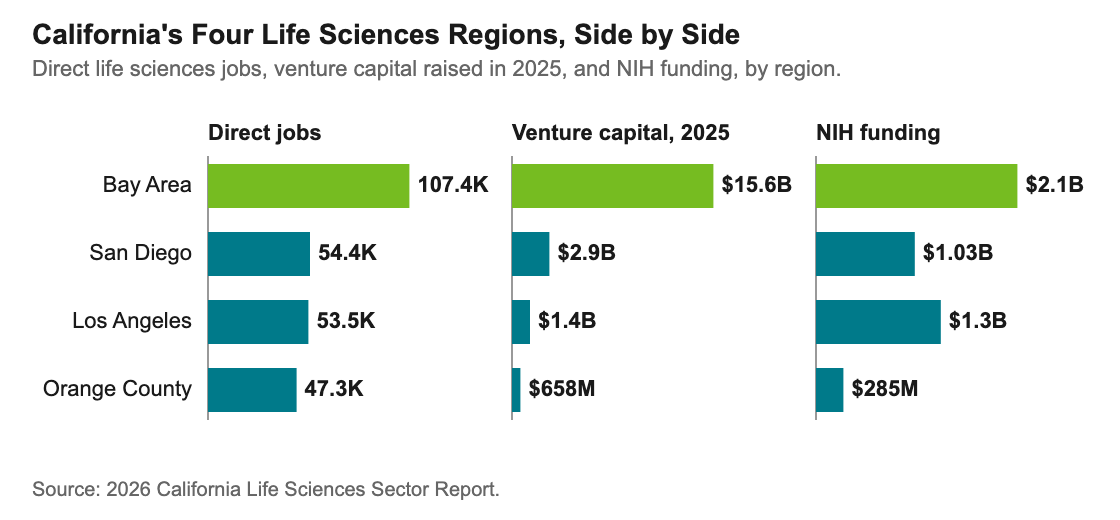
The Bay Area leads on every measure of size, and its venture capital is more than three times the other three regions combined.
2. Bay Area biotech companies and research: the global biopharma hub
Bay Area at a Glance
| Direct jobs | 107,409 (201,674 total supported) |
| Job concentration | 2.12x the U.S. |
| Venture capital, 2025 | $15.6B (+25.3%) |
| NIH funding | $2.1B |
| Signature subsector | Biopharma, 45% of jobs |
| Median pay | Medical scientist $164K–$165K · Biological technician $75K–$103K |
| Lab space | 28.5% vacant · $66.32/sq ft |
| Typical rent | $2,900–$4,800/month |
Sources: 2026 California Life Sciences Sector Report; California EDD, Q1 2026; Cushman & Wakefield, Q3 2026; Zillow, Sept. 2026. Pay and rent ranges span the region’s core counties.
The Bay Area is where the biotech industry began. Genentech was founded in 1976 to make medicines with recombinant DNA, and it is still headquartered in South San Francisco. Fifty years later, the region holds about one-third of California’s life sciences jobs, and biopharma research and manufacturing account for 48,266 of them.
The research base is the deepest in the state. Its universities, led by UCSF, Stanford, and UC Berkeley, spend $3.69 billion a year on life science research, and independent institutes such as the Gladstone Institutes add to that depth. The region’s technology industry also makes it the main place where life sciences and AI overlap, in drug discovery, protein design, and data infrastructure. Bay Area biotech companies drew $15.6 billion in venture capital in 2025, nearly three-quarters of the state’s life sciences total.
Under pressure. The money is concentrating. Venture dollars rose 25.3% in 2025, but the number of deals fell 8.7%, so fewer companies got more of the funding. Employment fell in every subsector, led by research and testing labs (−9.1%). And the region is carrying a large lab surplus after a building boom: 28.5% of Bay Area lab space was vacant in the third quarter of 2026, according to Cushman & Wakefield. Housing is moving the other way. San Francisco rents rose 26% in a year, to about $4,800 a month, which also makes hiring more expensive.
3. San Diego biotech and pharmaceutical companies: the startup base
San Diego at a Glance
| Direct jobs | 54,398 (150,385 total supported) |
| Job concentration | 2.48x the U.S. |
| Venture capital, 2025 | $2.9B (−34.4%) |
| NIH funding | $1.03B |
| Signature subsector | Biopharma, 52% of jobs |
| Median pay | Medical scientist $135K · Biological technician $69K |
| Lab space | 27.6% vacant · $66.25/sq ft |
| Typical rent | $2,970/month |
Sources: 2026 California Life Sciences Sector Report; California EDD, Q1 2026; Cushman & Wakefield, Q3 2026; Zillow, Sept. 2026.
San Diego has the most concentrated life sciences workforce in California, at nearly two and a half times the national share. Its industry is built on a short stretch of Torrey Pines Mesa, where the Salk Institute, Scripps Research, UC San Diego, and Sanford Burnham Prebys sit within a few miles of each other. UC San Diego alone accounts for $1.17 billion of the region’s $1.73 billion in university life science research.
The region’s startup culture traces to Hybritech, founded in 1978 to make diagnostic tests from monoclonal antibodies. When Eli Lilly bought it in 1986, its alumni stayed and founded companies including IDEC Pharmaceuticals, Gen-Probe, and Ligand, a pattern of founders reinvesting in the next generation that still defines San Diego. Illumina, the genomic sequencing company, is the best-known company to come out of that ecosystem. More than half of San Diego’s life sciences jobs are in biopharma, and the region is strong in drug discovery, neuroscience, oncology, and vaccines.
Under pressure. San Diego had the hardest 2025 of the four regions. Employment fell 4.0%, venture funding fell 34.4%, and NIH funding slipped 1.6%. Medical device jobs fell 10.9%. Lab vacancy has risen for three straight quarters, to 27.6%, and another 844,575 square feet is under construction. For companies looking for space, that means choice and leverage. For the region, it means the buildings arrived faster than the companies to fill them.
No-Cost Startup Mentorship
FAST California is a 12-week, no-cost, equity-free mentorship program for early-stage life sciences founders. Applications are accepted on a rolling basis.
4. Los Angeles biotech companies: research and clinical depth
Los Angeles at a Glance
| Direct jobs | 53,478 (149,507 total supported) |
| Job concentration | 0.75x the U.S. |
| Venture capital, 2025 | $1.4B (−17.2%) |
| NIH funding | $1.3B (+4.1%) |
| Signature subsector | Biopharma, 33% of jobs |
| Median pay | Medical scientist $138K · Biological technician $71K |
| Lab space | 3.8% vacant · $33.32/sq ft (LA–Orange County market) |
| Typical rent | $2,810/month |
Sources: 2026 California Life Sciences Sector Report; California EDD, Q1 2026; Cushman & Wakefield, Q3 2026; Zillow, Sept. 2026.
Los Angeles has the second-largest university research base in California, at $2.38 billion, led by UCLA ($1.34 billion) and USC ($854.8 million), with Caltech adding $100.5 million. Its hospitals give it unusual clinical depth: City of Hope and Cedars-Sinai run large research and trial programs alongside patient care. Its NIH funding grew 4.1% in 2025, the fastest of the four regions.
That research is turning into companies. Kite Pharma, based in Santa Monica, won FDA approval in 2017 for Yescarta, one of the first two CAR T-cell therapies approved in the United States. LA’s life sciences venture funding is the most diversified in the state: 42% went to pharmaceuticals and biotech in 2025, 25% to healthcare IT, and 24% to medical devices. Biopharma employment grew 2.3% last year, the fastest of the four regions.
Under pressure. Los Angeles is a large life sciences region inside a much larger economy, so its job concentration is 25% below the national average. Venture funding fell 17.2% and deals fell 15.6%, and research output has not yet produced companies at the rate the Bay Area and San Diego do. Lab space is the opposite problem from the north: the combined Los Angeles–Orange County lab market has 8.6 million square feet, about a third of San Diego’s, and only 3.8% of it is vacant. Companies that need to grow here may face challenges in finding the space they need to do so.
5. Orange County medical device companies: the medtech capital
Orange County at a Glance
| Direct jobs | 47,257 (114,093 total supported) |
| Job concentration | 1.85x the U.S. |
| Venture capital, 2025 | $658M (+88.9%) |
| NIH funding | $285M |
| Signature subsector | Medical devices, 49% of jobs |
| Median pay | Medical scientist $139K · Biological technician $62K |
| Lab space | 3.8% vacant · $33.32/sq ft (LA–Orange County market) |
| Typical rent | $3,250/month |
Sources: 2026 California Life Sciences Sector Report; California EDD, Q1 2026; Cushman & Wakefield, Q3 2026; Zillow, Sept. 2026.
Orange County is California’s medtech capital. Almost half of its 47,257 life sciences jobs, 22,960 of them, are in medical devices and equipment, one of the highest concentrations of medtech employment in the country. Edwards Lifesciences, the heart valve company, and Masimo, which makes patient monitoring technology, are both headquartered in Irvine. UC Irvine anchors the region’s $426 million university research base.
Investors noticed. Orange County venture funding rose 88.9% in 2025 to $658 million, the fastest growth of any California region, and 58.5% of it went to medical devices and supplies. Jobs in research, testing, and medical labs grew 21.1%.
Under pressure. The venture growth came from fewer, larger rounds: the number of deals fell 24.3%, the steepest drop of the four regions. Biopharma jobs fell 4.8%, and the research base is the smallest in the state, a fraction of Los Angeles’s next door. Orange County shares the region’s tight lab market, so companies scaling here may find themselves competing for space.
6. Choosing a region for your company or career
California’s life sciences industry is an ecosystem, and relationships between the regions, and even between competitors, are generally symbiotic. That said, each region has its own specific advantages.
| If you need… | Look at… | Why |
|---|---|---|
| Venture capital at scale | Bay Area | About three-quarters of California’s life sciences VC |
| A dense biotech hiring pool | San Diego | The highest job concentration in the state, 2.48x the U.S. |
| Lab space you can move into now | Bay Area or San Diego | More than a quarter of lab space is vacant, and renters have some leverage as a result |
| Lower lab rents | Los Angeles or Orange County | About $33 per square foot, half the Bay Area and San Diego rate, if you can find space |
| Research and clinical partners | Los Angeles | $2.38B in university research and the fastest NIH growth of the four regions in 2025 |
| Medical device talent and suppliers | Orange County | Almost half of jobs in devices |
| Lower living costs for your team | Los Angeles or San Diego | Typical rents near $2,800–$3,000 a month, against up to $4,800 in the Bay Area |
Pay follows the cost of living. A medical scientist earns a median of about $164,000 in the Bay Area and $135,000 to $139,000 in the three Southern California regions. Pay figures are base wages from the California Employment Development Department and leave out equity and bonuses, which matter in startup offers. For a fuller picture of what life sciences jobs pay in California, see our guide to biotech salaries in California.
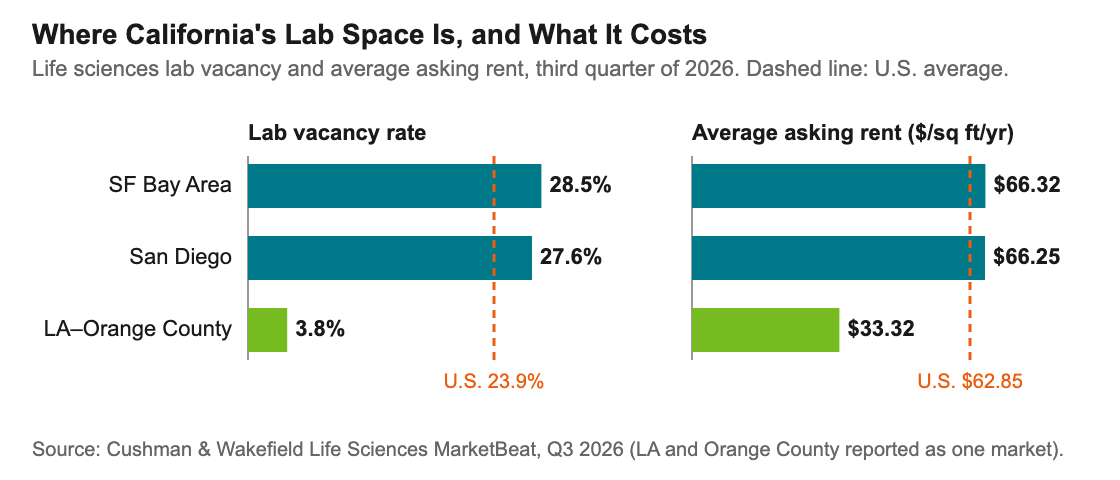
Lab space in Los Angeles and Orange County rents for about half the Bay Area and San Diego rate, but almost none of it is empty.
Many companies end up using more than one region: a Bay Area startup with a San Diego manufacturing partner, or an Orange County device maker recruiting engineers from Los Angeles. That’s just one advantage of a state with four distinct and interconnected regions.
One industry, four regions: how CLS supports them all
Our programs, from FAST California for early-stage founders to the CLSAdvantage cost-savings program, are open to CLS members wherever they are based.
The pressures in this comparison are real. Venture money is concentrating in fewer companies, San Diego lost jobs and funding in 2025, and California’s life sciences employment fell 1.8% while the U.S. total grew. These are statewide challenges, and regardless of which region life sciences companies in California call home, the overall industry is stronger facing them together.
There are also good reasons for confidence. Life sciences venture investment in California has grown two years running, from $15.1 billion in 2023 to $21 billion in 2025. The lab market appears to have turned: national lab vacancy fell in the third quarter of 2026 for the first time in four years, the Bay Area leased more space than it gave back, and no new buildings are adding to its surplus. And the regions cover for one another. In the year San Diego lost ground, Orange County’s venture funding nearly doubled and Los Angeles added biopharma jobs. Whichever region a company calls home, it can draw on the other three.
Explore CLS Membership
California Life Sciences membership connects you to California’s leading life sciences network — from advocacy and cost savings to exclusive events and programming.
FAQ: California's pharmaceutical industry by region
The Bay Area is the largest, with 107,409 direct life sciences jobs and $15.6 billion in venture capital in 2025, according to the 2026 California Life Sciences Sector Report. It is home to Genentech, founded in 1976 and widely credited with starting the biotech industry.
Yes. San Diego has the most concentrated life sciences workforce in California, at 2.48 times the national average, with 54,398 direct jobs. Its companies cluster around Torrey Pines Mesa, near the Salk Institute, Scripps Research, and UC San Diego.
The Bay Area has about twice as many jobs and higher pay, with medical scientists earning a median of about $164,000, against $135,000 in San Diego. San Diego has lower rents and a denser biotech community, though its employment fell 4.0% in 2025.
Yes. Los Angeles has 53,478 direct life sciences jobs and the second-largest university research base in California, led by UCLA and USC. Its NIH funding grew 4.1% in 2025, the fastest of California’s four main regions.
Almost half of Orange County’s 47,257 life sciences jobs are in medical devices, one of the highest concentrations in the country. Edwards Lifesciences and Masimo are both headquartered in Irvine.
California’s life sciences industry employs 336,505 people directly and supports 1.02 million jobs in total, more than any other state, according to the 2026 California Life Sciences Sector Report.