
NIH Funding Cuts: What They Mean for California Life Sciences
- Why California’s NIH total rose while new awards fell
- What has changed at NIH since 2025
- How federal research funding reaches California companies
- SBIR and STTR: six months without the startup programs
- How NIH funding changed across California’s four hubs
- What to watch through 2027
- Conclusion: Accounting vs. Real-World Impact
- California is the nation’s largest recipient of National Institutes of Health funding, with $5.246 billion in 2025, according to the 2026 California Life Sciences Sector Report.
- That total rose 1.7% from 2024, even as NIH terminated grants and made fewer new awards. The reason is accounting: NIH paid more multi-year grants up front, which raises one year’s total while funding fewer projects.
- The number that shows how many new projects get funded is the count of awards. NIH made 8,161 competing research grants in FY2025, the fewest since 1998, and funded 13% of applications, the lowest rate on record.
- The federal small-business research programs, SBIR and STTR, lapsed from October 1, 2025 until reauthorization on April 13, 2026. NIH alone invests over $1.4 billion a year through those programs.
- San Diego and Orange County saw NIH funding decline by 1.6% and 1.5% respectively, even with the accounting boost. Los Angeles (+4.1%) and the Bay Area (+1.3%) rose.
- NIH is operating under a continuing resolution through December 11, 2026. The FY2027 budget is unresolved at the time of writing.
- For FY2027, the President proposed a cut of about $5 billion, and a House committee bill holds funding roughly flat.
California’s life sciences industry was built where federal research money meets private capital. Academic labs funded by NIH produce the discoveries, the patents, and the trained scientists that fuel companies’ growth.
Since early 2025, NIH has terminated grants, slowed new awards, and changed how it pays out the awards it does make. The small-business research programs that seed many biotech startups lapsed for six months. About 80 cents of every NIH dollar goes out as grants and contracts to universities, medical schools, and other research institutions. Anyone founding or running a life sciences company, or hiring scientists, will feel these changes too, most of them a year or two after they reach academic institutions.
Meanwhile, our own 2026 Sector Report shows California’s NIH funding going up in 2025.
But both things are true, and the gap is the most useful thing to understand about the impact of the changes to federal research and other funding.
In this post, we’ll discuss what has changed, how to read the numbers, and how the effects travel from a university lab to a California company.
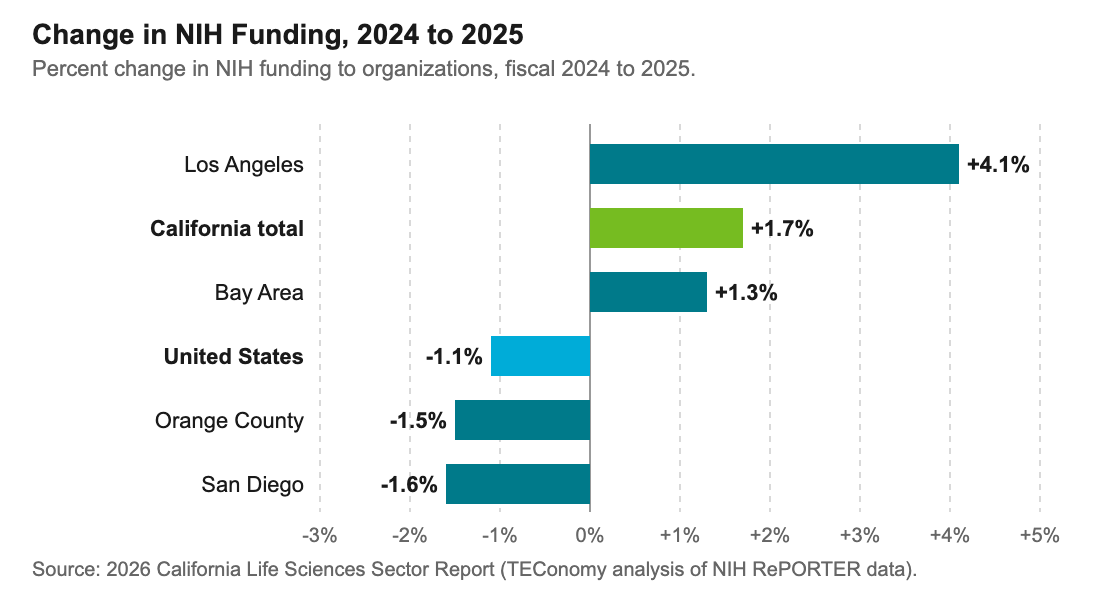
California’s NIH total rose in 2025 while the national total fell, but San Diego and Orange County declined even with the accounting boost.
1. Why California’s NIH total rose while new awards fell
Historically, NIH paid out most multi-year grants one year at a time. A five-year grant would be split across those five years in NIH accounting. In 2025, NIH began paying a larger share of new grants up front, so the same five-year grant would hit the NIH books in the year it was committed.
A state’s total can hold steady or rise while fewer investigators, labs, and young companies get funded. The 2026 Sector Report notes this directly: 2025 figures “reflect a change in NIH grant accounting,” with a larger share of awards funded up front as multi-year obligations. A Congressional Research Service analysis of NIH policy adds the consequence: paying grants up front reduces the total number of grants NIH can award in a given year.
It’s not just accounting: the same dollars that once covered the first year of five projects now fund one project in full. The award count, not the dollar total, is the better gauge of how many new projects are getting started.
NIH’s own figures show the shift. Competing research project grants fell from 10,265 in FY2024 to 8,161 in FY2025, the fewest since 1998, even as applications rose 13%. NIH funded 13% of the applications it reviewed, the lowest success rate in its records going back to 1970.
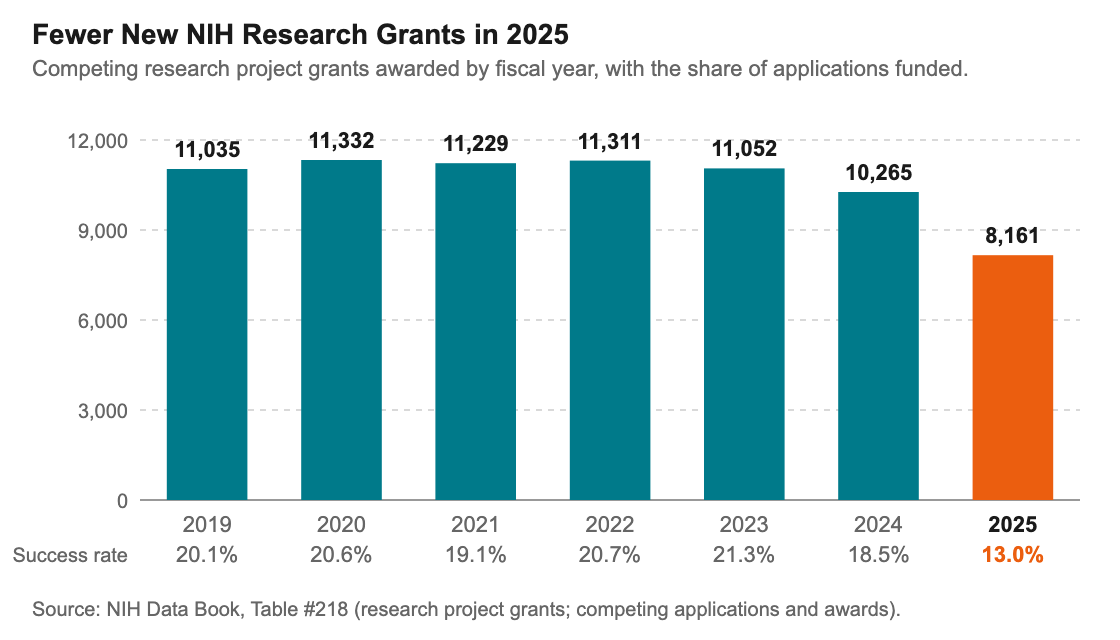
NIH awarded about 11,000 new research grants a year through 2023. In 2025 it made 8,161, and funded 13% of applications.
What to watch for
- Award counts and success rates, published in the NIH Data Book, rather than total dollars
- Whether Congress keeps limiting multi-year funding. The FY2026 appropriations act capped up-front awards at the FY2025 level, and NIH’s FY2027 budget proposal would expand them
2. What has changed at NIH since 2025
Several separate actions overlap, which is part of why the coverage is confusing. Here is where each stands as of late October 2026.
| Change | What happened | Status |
|---|---|---|
| Grant terminations | Federal agencies, including NIH, terminated research grants in bulk starting in early 2025. Grant Witness counts 782 federal grants terminated in California since January 2025 | Most restored under court orders; dozens remain canceled. NIH publishes no official tally |
| 15% indirect cost cap | NIH tried to cap the facilities and administrative costs it reimburses at 15% | Blocked. The First Circuit upheld the injunction in January 2026 and the government did not appeal |
| Multi-year funding | More grants paid up front for all years at once | Continuing. Capped at the FY2025 level for FY2026 |
| SBIR/STTR lapse | Authorization expired October 1, 2025. NIH withdrew its open small-business funding announcements in November 2025 | Reauthorized through September 30, 2031, signed April 13, 2026 |
| FY2027 budget | The President’s request is about $41.5 billion, $5 billion below the FY2026 program level | Unresolved. NIH is on a continuing resolution at FY2026 levels through December 11, 2026 |
Termination counts vary widely by tracker and date range. Grant Witness compiles terminations from public records, and its California figure covers January 2025 onward as reported by EdSource.
Universities have felt this most directly. University of California faculty received more than $2.7 billion in NIH funding in FY2024. Most terminated California grants have since been restored by court order, but EdSource reports that dozens remain canceled, including a training program at UCSF‘s Center for AIDS Research.
3. How federal research funding reaches California companies
Most California life sciences companies never receive an NIH grant directly. That doesn’t mean they’re unaffected. NIH funding reaches them, and helps build California’s life sciences sector, through three routes.
The science: Companies are built on discoveries made in NIH-funded labs, licensed out through a university’s technology transfer office. When CLS spoke out on NIH funding in February 2025, our statement described research institutions as “the bridge between early-stage research into industry-ready applications in cancer, diabetes, heart disease, and other conditions.” Fewer new awards today means fewer discoveries ready to license in a few years.
The people: NIH grants pay the graduate students and postdoctoral researchers who become industry’s scientists. At least 24 UC and California State University campuses lost NIH training grants that paid student stipends, CalMatters reported in May 2025. For an employer, that is a hiring pipeline that narrows several years from now.
The customers: Academic labs buy instruments, reagents, research tools, and services from California companies, including contract research organizations. There is a knock-on effect when a lab sees grants reduced or eliminated.
Reliable numbers on these effects are hard to come by. The 2026 Sector Report shows California life sciences employment fell 1.8% in 2025 while U.S. employment grew 0.5%. No single factor explains that decline. The routes above are why federal research funding belongs on any California company’s list of things to track.
What to do
- Employers: talk to the university labs you recruit from about how their training grants and postdoc positions are holding up
- Companies licensing academic IP: ask technology transfer offices which programs in your area have lost funding before you plan your next sourcing cycle
- Research-tools and service providers: watch NIH award counts in your customers’ fields, not just total dollars awarded
4. SBIR and STTR: six months without the startup programs
For startups, the most direct effect was not an NIH grant termination. It was the lapse of the Small Business Innovation Research (SBIR) and Small Business Technology Transfer (STTR) programs, the largest source of non-dilutive federal funding for life sciences founders.
NIH is the most active SBIR/STTR funder in life sciences, investing over $1.4 billion a year in small-business R&D through the two programs, as our founder’s guide to life sciences grants in California explains. When congressional authorization expired on October 1, 2025, NIH could not make new awards, and in November it withdrew its open funding announcements entirely.
Congress reauthorized both programs, and the law was signed on April 13, 2026, extending them through September 30, 2031. CLS pressed for reauthorization throughout the lapse, including a statement from CEO Mike Guerra. NIH reissued its SBIR/STTR funding announcements in summer 2026, with the first standard receipt date in September.
But the lapse left a gap that founders are still working through. A company that planned a Phase I award for spring 2026 lost most of a year. Because federal grants typically take six to 12 months from application to first payment, a company applying now should not expect funds until well into 2027.
What to do
- Check current solicitations at sbir.gov and the NIH SEED portal before you build a 2027 budget around an award
- Layer your sources. State funding through CIRM, California’s stem cell and gene therapy agency, and other programs in our grants guide can carry work that would otherwise wait on a federal award
- Plan runway for a long award timeline. Assume six to 12 months from submission to first payment
5. How NIH funding changed across California’s four hubs
Each of California’s four major life sciences hubs, the Bay Area, Los Angeles, Orange County, and San Diego, depends on NIH funding differently, and 2025 played out differently in each.
| Region | NIH funding, 2025 | Change from 2024 | Key NIH focus areas |
|---|---|---|---|
| Bay Area | $2.1 billion | +1.3% | Arthritis, musculoskeletal, and skin disease |
| Los Angeles | $1.3 billion | +4.1% | Cancer, health disparities, dental and craniofacial |
| San Diego | $1.03 billion | -1.6% | Allergy and infectious disease, drug abuse, translational science |
| Orange County | $285 million | -1.5% | Aging, child health, eye research, translational science |
Source: 2026 California Life Sciences Sector Report, TEConomy analysis of NIH RePORTER data.
San Diego and Orange County declined even under an accounting change that props up annual totals, so the underlying drop in new awards there is likely larger than the dollar figures show. San Diego, which the Sector Report calls California’s “startup dynamo and research powerhouse,” leans heavily on the research institutions that feed its startups. UC San Diego is among the state’s top five NIH recipients.
The Bay Area, home to UCSF and Stanford, receives the largest share and still grew. Los Angeles grew fastest, led by UCLA and USC.
6. What to watch through 2027
Federal research funding for FY2027 is still open, and several decisions will land in the next few months.
- December 11, 2026. The continuing resolution funding NIH at FY2026 levels expires. Congress returns (or returned, depending on when you’re reading this) on November 9, and the options include another stopgap, a broader spending bill, or a lapse. Under the current resolution, NIH may make some ongoing awards below their previously approved levels (NOT-OD-26-131).
- The FY2027 NIH budget. The President requested about $41.5 billion. The House Appropriations Committee advanced a bill in June that rejected the cut and added about $100 million over FY2026. The Senate has not marked up its version.
- Multi-year funding rules. Whether Congress keeps capping up-front awards will shape how many new grants NIH can make, regardless of the top-line number.
- NIH’s FY2026 award data. Early reports on FY2026 suggest award counts remain well below their 2021 to 2024 average. NIH’s own figures, when published, will show whether that held through the year.
- State action. Governor Newsom signed SB 895 on September 30, 2026, placing a $7.5 billion science and health research bond on the March 7, 2028 ballot. It would fund grants and loans to public and private research institutions.
Conclusion: Accounting vs. Real-World Impact
On paper, California’s NIH total held up in 2025. On the ground though, the number of projects did not. For a California company, the dollar figure isn’t as important as the number of awards because that speaks to how many new discoveries, trained scientists, and startup awards the money can help drive.
Those effects arrive slowly, and they arrive first in the regions and companies closest to academic research. The companies that track award counts, plan around the SBIR timeline, and keep close to the labs they hire from will see them coming.
FAQ: NIH funding cuts and California life sciences
California received $5.246 billion in NIH funding in 2025, more than any other state, and the total rose 1.7%. Behind that total, NIH made fewer new awards nationwide, and hundreds of federal research grants in California were terminated, most later restored by court order. San Diego and Orange County saw NIH funding decline.
In 2025 NIH paid a larger share of grants up front for all years of the project. That raises one year’s total while funding fewer projects. The number of new awards is a better measure of how many projects are being started.
Most biotech companies feel NIH changes indirectly. Fewer academic grants mean fewer discoveries to license, fewer trained scientists entering industry, and less lab spending on research tools and services. Startups were hit directly when the SBIR and STTR programs lapsed from October 2025 to April 2026.
Yes. Congress reauthorized both programs through September 30, 2031, and the law was signed on April 13, 2026. NIH has reissued its SBIR and STTR funding announcements. Check sbir.gov and the NIH SEED portal for current deadlines.
No. Federal courts blocked the cap, an appeals court upheld that decision in January 2026, and the government did not seek Supreme Court review. Institutions continue to use their negotiated indirect cost rates.
As of late October 2026, Congress has not passed an FY2027 budget for NIH. NIH is funded at FY2026 levels under a continuing resolution through December 11, 2026. The President proposed about $41.5 billion, and a House committee bill would hold funding roughly flat.